

Maths tutor near you in Newcastle, NSW
For students who benefit from patient, individualized guidance, online maths tutoring delivers structured one-on-one instruction. Learners in Newcastle work through number, algebra, geometry, and calculus, with focused NAPLAN and HSC preparation toward strong ATAR results. Each session is shaped around the student's pace and goals, turning difficult topics into dependable understanding.
Free Trial
15-days refund
Free tutor swap
No cancel fee
Summary
Podcast

We match you with best tutors for your requirements

Students in Newcastle community improving with Maths support
Tuition offered near Merewether, Hamilton
Reshma taught 10 days ago
The Student and Tutor reviewed factoring cubic and quadratic expressions using various methods, including the sum/difference of cubes formulas, factoring by grouping, and a technique involving finding a root and performing polynomial long division. The Student practiced several factoring problems from a worksheet. For follow-up, the Student was encouraged to practice long division and continue working on the provided factoring worksheet.
Factoring Cubics: Sum and Difference of Cubes
Factoring Cubics by Grouping
Factoring Cubics using the Factor Theorem & Polynomial Long Division
Factoring Quadratic Trinomials (x² + bx + c)
Difference of Squares Formula
Hussan ul taught 27 days ago
The Student and Tutor reviewed two homework problems: finding pairs in an arithmetic progression that sum to a specific number, and maximizing the product of three integers with a given sum. They then transitioned to Combinatorics, working on fundamental 'n choose k' concepts and solving problems involving seating arrangements. The session concluded with an introduction to a challenging polynomial division problem, which was set for continuation in the next class.
Arithmetic Progressions & Distinct Integers
Maximizing Products for a Fixed Sum
Permutations and Constrained Seating
Combinations (Choosing Items)
Polynomial Division and Remainder Theorem
Rahul taught about 1 month ago
The Student and Tutor reviewed the process of finding the inverse of a matrix to solve systems of linear equations, practicing calculations for co-factors, adjoints, and determinants. The session then introduced the new academic concept of eigenvalues and eigenvectors, including their fundamental equation and characteristic equation. They worked through a 2x2 matrix example to calculate eigenvalues, and the Student will review this new concept for the next class.
Setting Up Matrix Equations (Ax=B)
Calculating Co-factors and Adjoint Matrix
Determinant of a Matrix
Solving Systems with Inverse Matrix (X = A⁻¹B)
Introduction to Eigenvalues (λ) and Eigenvectors (x)
The Characteristic Equation for Eigenvalues
Calculating Eigenvalues via Quadratic Equation
Cherubim taught about 1 month ago
The Student and Tutor reviewed homework involving single-digit addition and subtraction. They then learned and practiced two-digit addition and subtraction, focusing on aligning numbers and solving by place value without regrouping or borrowing. The Tutor assigned the remaining practice problems as homework for the Student.
Review of Single-Digit Addition & Subtraction
Vertical Two-Digit Addition (Without Regrouping)
Vertical Two-Digit Subtraction (Without Borrowing)
Strategic Place Value Alignment
Developing Speed and Accuracy in Math Operations
Rahul taught about 2 months ago
The session focused on practicing essential matrix operations, with the Student and Tutor reviewing and working through problems on determinants and co-factors of 3x3 matrices. The Student practiced calculations for two different matrices, identifying and correcting errors related to handling negative signs. They also briefly touched upon adjoint matrices, with plans to cover invertible matrices in the upcoming class and the Tutor offering supplementary practice worksheets.
Calculating Determinants
Finding Co-factors of a Matrix
Adjoint of a Matrix
Inverse of a Matrix (Invertible Matrices)
Cherubim taught about 2 months ago
The session began with the Student and Tutor reviewing homework on addition word problems. The Tutor then introduced and practiced subtraction concepts, focusing on "taking away" numbers up to 10 using visual aids and counting strategies. Homework was assigned to reinforce these subtraction skills, and future lessons will cover a review of addition and subtraction, word problems, and shapes.
Reviewing Addition and Word Problems
Understanding Subtraction: "Take Away"
Visual Subtraction with Objects
Subtraction Strategies: Counting On & Counting Backward
Solving Subtraction Word Problems & Number Relationships
Maths tutor in Newcastle for algebra, calculus and statistics


Find experienced maths tutors near Newcastle
HSC experts for homework and exam success
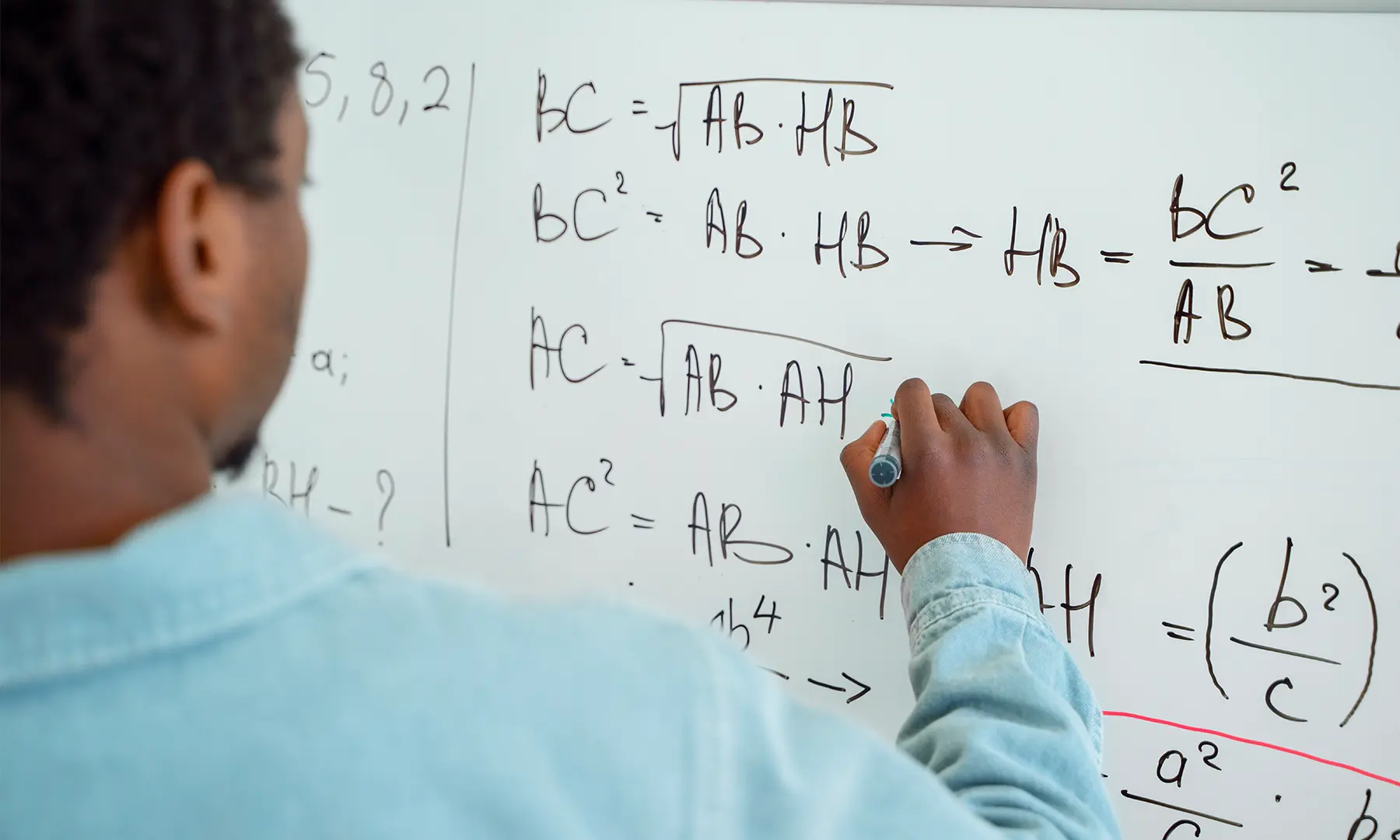


Maths tutors in Newcastle helping students gain confidence and clarity

Newcastle’s schools and universities continue to nurture a new generation of problem solvers. From lessons at Merewether High School to workshops at the University of Newcastle, students across the city are developing essential skills for the future. Yet many learners still carry myths about maths that limit their progress. Tutors in Newcastle are helping students uncover the truth about learning maths, showing that success comes from understanding, not fear.
Myth: You must be naturally good at maths
Many students believe that only those with a special talent can excel in maths, creating anxiety before they even begin.
Fact: Tutors across Hamilton and The Junction emphasise that mathematical thinking is developed through practice. Lessons often start with simple logic puzzles and reasoning challenges that show how problem-solving skills grow over time. As learners realise that maths is a trainable skill, their confidence increases with consistent effort.
Myth: Memorising formulas is enough to succeed
Some students depend entirely on memorisation, which leads to mistakes when problems look different from textbook examples.
Fact: Tutors in Kotara and Charlestown focus on understanding rather than repetition. Practical exercises such as budgeting, cooking, or sports scoring make lessons relatable. When students connect formulas to everyday applications, they understand their purpose and remember them more effectively.
Myth: Mistakes mean you are bad at maths
Fear of being wrong stops many learners from trying, reinforcing low confidence.
Fact: Tutors near Adamstown create supportive learning environments where mistakes are treated as part of growth. Learners revisit incorrect steps, analyse what went wrong, and practise improvement strategies. This reflection turns errors into tools for progress and builds resilience in problem-solving.
Myth: Calculators make students lazy
Some believe technology weakens critical thinking skills.
Fact: Tutors across Mayfield teach students to use calculators as tools for verification rather than shortcuts. Exercises include solving problems manually and then checking results with technology. This blend of mental calculation and digital accuracy strengthens understanding while encouraging precision.
Myth: Maths is not creative
Students often think creativity belongs only to art or writing.
Fact: Tutors in Carrington show that creativity in maths comes from exploring multiple ways to solve the same problem. Lessons include logic games and pattern analysis inspired by design and nature. Students discover that analytical thinking and imagination work hand in hand.
Myth: Long study hours guarantee success
Some learners spend hours revising but still struggle to improve.
Fact: Tutors in Wallsend teach efficient study methods through short, focused sessions supported by regular breaks. By dividing topics into smaller goals, students retain more and avoid burnout. This structure shows that consistency, not exhaustion, drives long-term success.
Myth: Only high achievers need tutoring
Some families assume tutoring is only for advanced students or exam preparation.
Fact: Tutors near Stockton work with learners of every level. Whether revisiting basic concepts or preparing for higher studies, sessions are adapted to each student’s pace. Tutoring becomes a space for progress, confidence, and steady improvement, not competition.
Tutors across Newcastle are replacing fear with curiosity. By challenging long-held myths, they show that success in maths depends on patience, understanding, and persistence. Supported by the city’s learning spaces from community libraries to university classrooms, students who once doubted their abilities now approach numbers with confidence, knowing that progress is not a matter of talent but a journey built through effort and discovery.


