Chemistry tutor near me in San Antonio, TX
Build understanding through chemistry tutoring
Filters
Level
Topics
Specialities
Price
Education
Tools Used
Special Needs
Curriculum
Level
Topics
Chemistry
Organic Chemistry
Chemical Reactions
Physical Chemistry
Inorganic Chemistry
Analytical Chemistry
Show more
Specialities
Homework help
Test prep strategies
Visual learning
Personalized learning plans
Real world application
Review sessions
Show more
Price
Education
Tools Used
Digital whiteboard
Quizzes
Assessments
Show more
Special Needs
ADHD
ASD
Learning Disabilities
Show more
Curriculum
International Baccalaureate
Common Core State Standards
State-Specific Standards
Show more

San Antonio learners engage in interactive chemistry lessons
Alamo Heights, Stone Oak, Westside see ongoing chemistry learning
Robert taught 1 day ago
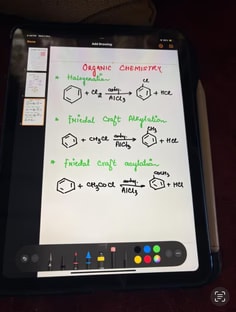
The student and tutor worked through a variety of organic chemistry reactions involving aldehydes and ketones. They practiced drawing detailed reaction mechanisms for acetal formation, imine/enamine synthesis, and the deprotection of carbonyl groups. The tutor reviewed the concepts and the student worked on applying them to specific problems.
Acetal and Hemiacetal Formation
Imine and Enamine Formation
Nucleophilic Addition Reactions of Carbonyls
Wittig Reaction
Protecting Groups in Organic Synthesis
Veena taught 9 days ago
The Tutor and Student reviewed the principles and applications of Mass Spectroscopy and Infrared (IR) Spectroscopy. They covered topics like molecular ion identification, fragmentation patterns, isotopic effects, and vibrational analysis of functional groups using IR. The session concluded with plans to review common fragments and rearrangements in mass spectrometry and further practice IR spectral interpretation.
Mass Spectrometry: The Basics
Infrared (IR) Spectroscopy: Vibrational Analysis
Interpreting IR Spectra: Key Regions and Bands
Mass Spectrometry: Fragmentation and Interpretation
Vaishnavi taught 17 days ago
The tutor and student worked through numerous examples of naming and drawing branched alkanes, reinforcing IUPAC nomenclature rules. They discussed foundational concepts like hybridization and reaction intermediates, which are prerequisites for understanding reaction mechanisms. The student plans to compile a list of topics for future sessions to focus on prerequisite knowledge for advanced organic chemistry.
Drawing Skeletal Structures of Alkanes
Principles of Numbering for Substituents
Continuous vs. Branched Carbon Chains
IUPAC Nomenclature of Alkanes
Manpreet taught 28 days ago
The Tutor and Student reviewed past assignments covering organic chemistry reactions, mechanisms, and reagents in preparation for an exam. They discussed topics such as oxidation, reduction, tautomerism, and stereochemical rules, and planned to continue with revisions in the next session.
Oxidation and Reduction Reactions
Reaction Mechanisms: Tautomerism
Stereochemistry and Addition Reactions
Functional Group Transformations: Alcohols
Srishti taught about 1 month ago
The tutor and student reviewed and solved several problems related to the ideal gas law and stoichiometry. They then delved into the conceptual understanding of the Kinetic Molecular Theory of Gases and its assumptions, as well as the distinction between natural laws and scientific theories. The session concluded with further practice problems applying these concepts.
Kinetic Molecular Theory (KMT) of Gases
Ideal Gas Law and KMT Relationship
Natural Law vs. Scientific Theory
Molar Mass Calculation using Ideal Gas Law
Nikita taught about 1 month ago
The student and tutor reviewed and practiced problems related to radioactive decay, including calculating activity and mass remaining over time using half-life. They also covered nuclear equations, particle identification, and balancing reactions, with a focus on alpha and beta decay.
Beta Decay Explained
Radioactive Decay and Half-Life
Nuclear Equations and Particle Notation
Test prep and homework help for chemistry in San Antonio


Highly rated chemistry tutoring nearby San Antonio
Stronger grades with homework-focused chemistry classes



San Antonio's Chemistry Crucible

Where Chemical Innovations Begin
The University of Texas at San Antonio (UTSA) boasts a comprehensive Department of Chemistry offering degrees up to the Ph.D. level. Its faculty and students are immersed in groundbreaking research spanning synthetic chemistry, advanced materials, analytical techniques for drug discovery, and environmental analysis. Recent cutting-edge research at UTSA includes the development of new antimicrobial compounds to combat resistant bacteria and the design of novel materials for more efficient energy storage. This vibrant research environment provides an exceptional setting for both undergraduate and graduate students to engage in hands-on projects, preparing them for advanced studies or direct entry into diverse scientific careers.
The University of Texas Health Science Center at San Antonio (UT Health San Antonio), a key component of the city’s “BioMedical City USA” designation, conducts extensive, chemistry-intensive research within its Biochemistry and Structural Biology departments. Their work directly impacts public health through studies on disease mechanisms, cancer therapies, and drug development, often involving complex chemical synthesis and analysis. Similarly, Trinity University in San Antonio provides an excellent undergraduate chemistry education with a strong emphasis on faculty-student research, often integrating environmental and biochemical aspects into their programs. These institutions collectively foster an intellectually stimulating environment, drawing aspiring chemists and creating a powerful engine for scientific progress.
Forging Futures: Collaborative Chemistry and Diverse Career Paths
San Antonio’s dynamic research ecosystem fosters strong collaborations that extend academic insights into real-world applications, shaping diverse career paths for chemistry graduates.
The city's strong biomedical and healthcare sectors, exemplified by UT Health San Antonio and military medical facilities like Brooke Army Medical Centre, create a robust demand for chemists in medical diagnostics, pharmaceutical research, and biotechnology. Chemists here might develop new vaccines, enhance drug delivery systems, or innovate medical devices. The energy sector, with entities like CPS Energy (San Antonio’s municipal electric and natural gas provider), also utilises chemical engineers and chemists for sustainable energy solutions, process optimisation in power generation, and environmental compliance.
For students exploring professional opportunities:
- Gain Hands-on Edge: Actively pursue research opportunities and internships at UTSA, UT Health San Antonio, or Trinity University. Such experiences provide invaluable lab skills and direct exposure to current research challenges, enhancing competitiveness for roles at organisations like Genentech (which has research presence in Texas) or other growing biotech firms.
- Contribute to Local Environmental Impact: Explore career pathways with environmental consulting firms in San Antonio or join the Edwards Aquifer Authority for roles focused on water quality analysis and environmental protection, a unique local niche where chemistry makes a direct community impact.
- Explore Interdisciplinary Roles: San Antonio's collaborative spirit means chemists often work alongside biologists, engineers, and medical professionals. Developing interdisciplinary skills can unlock opportunities in biomedical device development, forensics, or sustainable manufacturing within the city's diverse industrial landscape.