Physics tutor near me in Tallahassee, FL
Understand concepts with skilled physics tutor
Filters
Level
Topics
Specialities
Price
Education
Tools Used
Special Needs
Curriculum
Level
Topics
Nuclear Physics
Physics
Thermodynamics
Electromagnetism
Quantum Mechanics
Atomic Physics
Show more
Specialities
Homework help
Test prep strategies
Visual learning
Personalized learning plans
Real world application
Review sessions
Show more
Price
Education
Tools Used
Digital whiteboard
Quizzes
Assessments
Show more
Special Needs
ADHD
ASD
Learning Disabilities
Show more
Curriculum
International Baccalaureate
Common Core State Standards
State-Specific Standards
Show more

Inside recent physics classes taught in Tallahassee
Tutors serve learners in Betton Hills, Bradfordville, Golden Eagle
Soumya taught 28 days ago
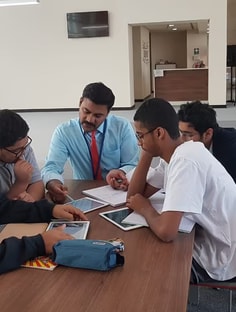
The tutor and student reviewed the definition and types of energy stores and transfers. They practiced applying the kinetic energy formula and solving related problems, and discussed the Law of Conservation of Energy. The tutor indicated that potential energy would be covered in the next class.
Definition of Energy
Types of Energy Stores
Energy Transfer
Law of Conservation of Energy
Kinetic Energy Formula
Emmanuel taught about 1 month ago
The tutor and student worked through a detailed problem on a vapor compression refrigeration cycle, calculating the refrigerating effect, coefficient of performance, and dryness fraction. They utilized ammonia property tables and thermodynamic formulas to determine these values, and the tutor assigned homework problems for future practice.
Vapor Compression Refrigeration Cycle
Refrigerating Effect (Q_L)
Coefficient of Performance (COP)
Dryness Fraction (x)
Saloni taught about 2 months ago
The student and tutor reviewed concepts in rotational motion, including moment of inertia and total kinetic energy for rolling objects. They then transitioned to electrostatics, covering the motion of charged particles in electric fields, applying kinematic equations, and comparing electric forces to gravitational forces.
Moment of Inertia
Rotational Kinetic Energy
Projectile Motion in Electric Fields
Conservation of Energy in Rolling Motion
Hareethha taught about 2 months ago
The Student and Tutor reviewed fundamental algebra concepts for a physics course. They worked through problems involving solving equations, finding common denominators, and handling quadratic equations, with the goal of strengthening the Student's algebraic skills. The Tutor outlined a plan to cover algebra from the basics in future sessions.
Solving Rational Equations
Quadratic Equations
Extraneous Solutions
Emmanuel taught about 2 months ago
The Tutor and Student worked on a problem involving the calculation of clearance changes in a pump plunger and barrel due to temperature variations. The student had gathered initial dimensions and the Tutor aimed to present detailed calculations and explanations, which were planned to be sent to the student due to technical sharing issues.
Pump Clearance Calculation
Temperature Effects on Dimensions
Unit Conversion in Engineering
Computational Errors in Engineering
Emmanuel taught about 2 months ago
The tutor and student reviewed physics homework problems covering forces, motion, and mechanics. They analyzed free-body diagrams, calculated resultant forces, and discussed concepts like buoyancy, drag, and Newton's laws. The next lesson will involve solving more problems from a provided link, with a focus on improving understanding of resultant forces and angles.
Free Body Diagrams and Force Resolution
Resultant Force and Vector Addition
Newton's Laws of Motion and Equilibrium
Forces in Fluids: Buoyancy and Drag
Students near Tallahassee boost grades with physics prep


Schedule private physics classes near Tallahassee
Physics tutoring for exam prep and concept clarity


How Physics and Magnetism Define Tallahassee

The Magnetic Heart of the City
The single most important and unique scientific feature in Tallahassee is the National High Magnetic Field Laboratory (MagLab), headquartered at Florida State University. This isn't just a university lab; it is the largest and highest-powered magnet laboratory in the world, funded by the National Science Foundation. The work done here is pure, powerful physics. Scientists at the MagLab use immense, continuous magnetic fields, some reaching an incredible 45 tesla (the strongest of their kind), to explore the fundamental properties of matter. The research is at the very core of condensed matter physics and materials science, investigating how electrons behave under extreme conditions to discover and characterise new materials, from next-generation superconductors to advanced polymers. The MagLab is a user facility, meaning thousands of physicists, chemists, and biologists from hundreds of institutions worldwide travel to Tallahassee to conduct experiments that are impossible anywhere else.
The Academic Engine: FSU and FAMU
This world-class facility is powered by a robust academic ecosystem, led by the city's two major universities.
- Florida State University (FSU): As the host institution for the MagLab, the FSU Department of Physics is a powerhouse in its own right. Its research programs are deeply integrated with the lab, with world-renowned groups in condensed matter physics, nuclear physics, and high-energy particle physics. The department also operates its particle accelerator, the John D. Fox Superconducting Accelerator Laboratory, allowing students and faculty to probe the structure of the atomic nucleus. This provides an incredibly rich environment where students can learn theoretical physics in the classroom and then walk over to a world-record-holding national lab to see it applied.
- Florida A&M University (FAMU): As a leading Historically Black College and University (HBCU), FAMU's Department of Physics plays a vital role in the city's scientific community. It provides a strong, research-focused undergraduate physics education, with specialisations in areas like medical physics and materials science. FAMU actively fosters opportunities for its students to engage in cutting-edge research through partnerships, including programs that connect them with mentors and projects at the MagLab, ensuring that the next generation of physicists is diverse and well-prepared.