
AMAN SHUKLA
AP Physics Tutor | 4+ Yrs Exp | Physics 1, 2 , C E&M | Clear Concepts, Better Exam Scores





Show all photos
AMAN SHUKLA
Bachelors degree
/ 55 min
AMAN - About your AP tutor
Hi, I'm Aman Shukla, an AP Physics tutor with 4+ years of experience. I help students understand concepts clearly instead of just memorizing formulas, and I cover AP Physics 1, 2, and C (Mechanics & E&M). My focus is on building strong basics along with practice on AP-style questions, so students feel confident and ready for the exam. I keep my teaching style patient and simple, explaining topics in a practical way — great for students who want both better understanding and better scores. Over the years, I have worked with students of different levels, from those just starting out with physics to those aiming for a top score on the AP exam. I believe every student can do well in physics if the concepts are explained the right way, with real-life examples and step-by-step problem solving. I also help students improve their exam technique, time management, and how to approach tricky FRQs. My goal is not just to help students pass the exam, but to help them actually enjoy physics and feel confident using it in the future. I also make sure sessions are interactive rather than one-sided lectures, so students can ask questions freely and clear their doubts as we go. Depending on each student's needs, I adjust my pace, use extra practice sheets, or revisit topics until concepts are fully clear before moving ahead.
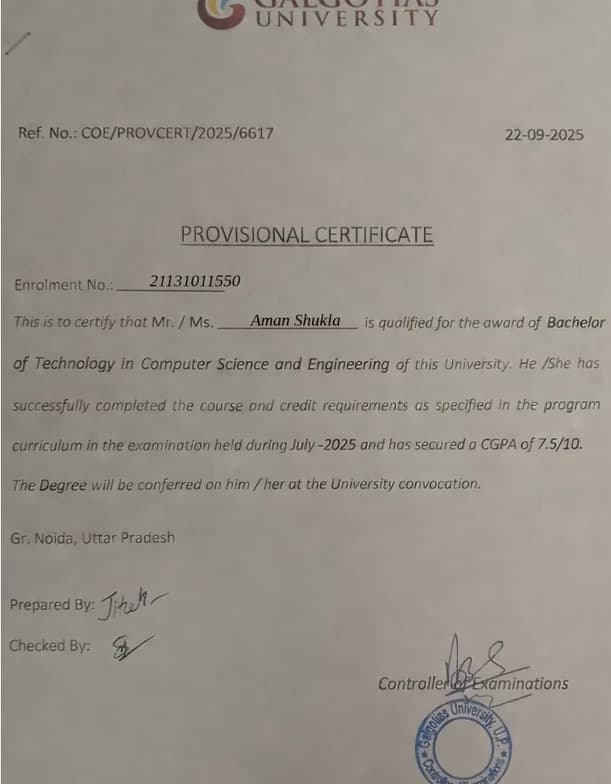
AMAN graduated from GALGOTIAS UNIVERSITY

AP tutor test prep specialities

Test taking techniques

Practice Exams

Grade improvement

College Credit

Concepts learning

Study Plans
 CoTutor
AI modules
Summary
Podcast
Quiz
Learnings
Flashcard
Spotlight
Zero Risk Guaranteed
15-days refund
Free tutor swap
No cancel fee
1-yr validity
24/7 support
AMAN - also teaches

AP Physics 1
AP Physics 2
AP Physics C: Electricity and Magnetism
AP Physics C: Mechanics

AP concepts taught by AMAN
The Student and Tutor practiced various physics problems related to wave phenomena, including Simple Harmonic Motion, Snell's Law, Young's double-slit experiment, and standing waves in strings and tubes. They also briefly discussed the Doppler effect and reviewed some concepts from the Student's recent exam. The Student plans to continue with sessions next week and the Tutor will send the practice document.
Snell's Law and Refraction
Young's Double-Slit Experiment & Wave Interference
Standing Waves on Strings
Standing Waves in Pipes (Open and Closed Ends)
The Superposition Principle
The Student and Tutor engaged in a review session for an upcoming unit test covering Kinematics and Dynamics. They worked through problem-solving exercises related to position-time equations and discussed how to interpret and sketch corresponding velocity-time and acceleration-time graphs.
Acceleration-Time (a-t) Graphs: Constant Motion
Velocity-Time (v-t) Graphs: Linear Motion
Position-Time (x-t) Graphs: Parabolic Motion
Foundations of Kinematics and Dynamics
Solving Quadratic Kinematic Equations
Chain Rule in Differentiation
Derivatives of Square Root Functions (using Chain Rule)
Derivatives of Exponential Functions (e^ax)
The Tutor and Student began their first session by discussing projectile motion, covering its definition, the role of vector components, and Galileo's statement on independent perpendicular motions. They derived formulas for time of flight, maximum height, and range, then applied these to solve practice problems. The Tutor assigned practice questions on one-dimensional motion for the Student to complete before the next class.
Introduction to Projectile Motion
Velocity Components and Independence of Motion
Formulas for Projectile Motion: Time of Flight
Max Height
and Range
Student and Tutor worked through various physics problems from past papers, including interpreting graphs for linear relationships, analyzing ideal gas behavior, identifying systematic experimental errors, and applying principles of circular motion and energy conservation. They also practiced unit analysis and discussed general strategies for problem-solving, particularly when to apply energy conservation. The Tutor agreed to send a forces document as follow-up.
Linearization of Equations & Graph Analysis
Systematic Errors in Experiments
Circular Motion in a Vertical Plane
Work-Energy Theorem & Conservation of Energy
Centripetal Force & Friction on a Flat Turn
Units Analysis in Physics
The Student and Tutor focused on reviewing exam-style questions covering key Physics concepts including work, energy, momentum, forces, black body radiation, projectile motion, circular motion, and spring combinations. They practiced problem-solving techniques for various scenarios, and the Tutor offered to share practice documents for the Student's upcoming exams.
Work-Energy Principle & Inelastic Collisions
Forces
Momentum & Projectile Motion
Black Body Radiation & Incident Solar Intensity
Circular Motion & Banking
Elastic Potential Energy & Spring Combinations
Practical aids used by AP tutor

Presentations

Study Planner

AP Assessments

Digital whiteboard

AP Practice worksheets

AP tutors on Wiingy are vetted for quality
Every tutor is interviewed and selected for subject expertise and teaching skill.
