
Prathyusha Pragada
Expert Physics Tutor for Concept Clarity, Exams, and Problem Solving Build Strong Physics Foundations with Interactive and Fun Learning



Show all photos
Prathyusha Pragada
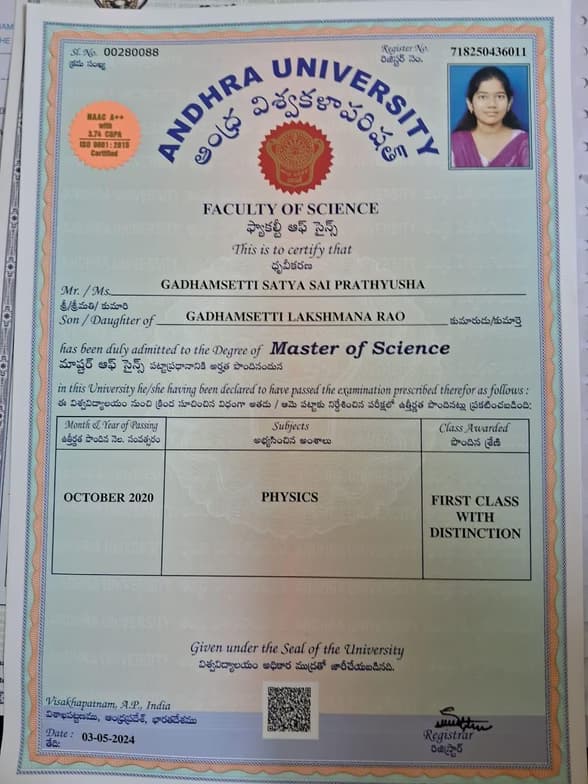
Masters degree
/ 55 min
Prathyusha - your physics tutor
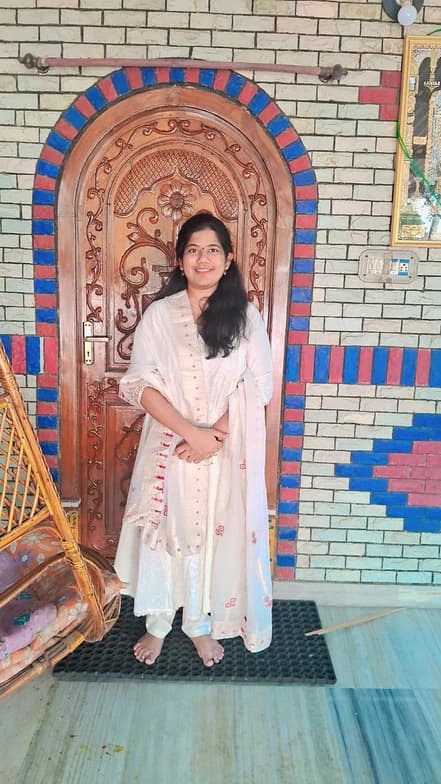
I am Prathyusha Pragada, a dedicated and enthusiastic Physics tutor with over 5 years of teaching experience. Holding a Master’s degree in Physics and a B.Ed, I specialize in making complex concepts like Atomic Physics, Electricity, Waves, and Oscillations simple and engaging for students from elementary to high school levels. My teaching philosophy revolves around a student-centered approach, where I focus on building strong conceptual clarity rather than rote learning. I believe that every student learns differently, so I design personalized lesson plans tailored to individual needs, pace, and goals. Whether it’s strengthening fundamentals, preparing for exams, or boosting confidence in problem-solving, I ensure each session is interactive and meaningful. I incorporate real-life examples, visual aids, and hands-on activities to make Physics relatable and interesting. In my classes, I encourage curiosity, critical thinking, and active participation. I also provide regular assessments, feedback, and strategies to help students improve consistently. Creating a supportive and inclusive learning environment is my priority, where students feel comfortable asking questions and expressing themselves. My ultimate goal is to inspire a love for Physics and help students achieve both academic success and lifelong learning skills.
Meet Prathyusha
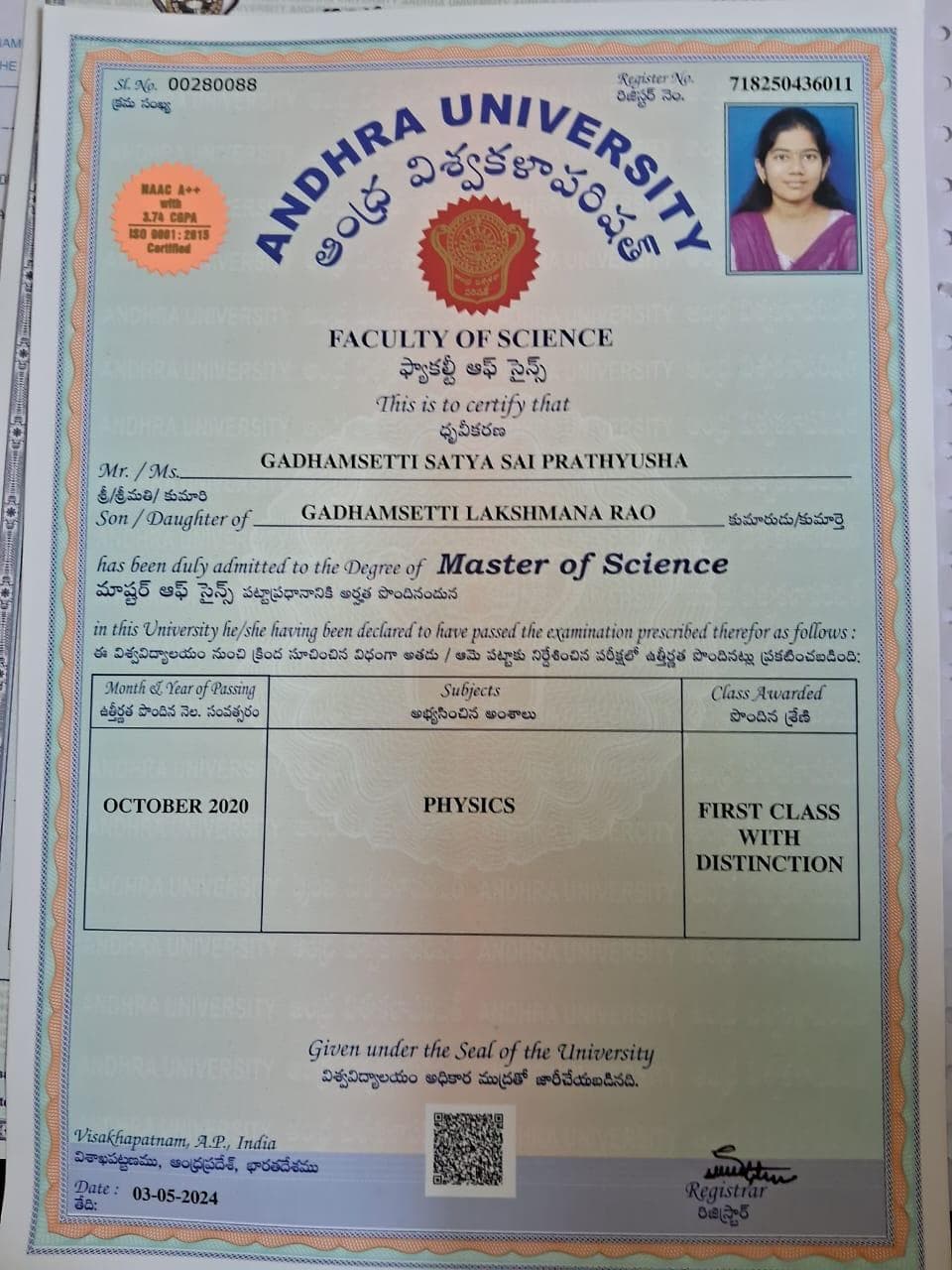
Prathyusha graduated from Andhra University
Academic expertise of your physics tutor

Visual learning
Career guidance
Personalized learning plans
Real world application

Homework help
 CoTutor
AI modules
Summary
Podcast
Quiz
Learnings
Flashcard
Spotlight
Zero Risk Guaranteed
15-days refund
Free tutor swap
No cancel fee
1-yr validity
24/7 support
Student types for physics class

Elementary School students
None of the above
Middle School students
High School students
Prathyusha - Physics tutor also teaches

Physics
Atomic Physics
Electricity
Waves and Oscillations

Physics concepts taught by Prathyusha
The class covered key concepts in quantum physics, including blackbody radiation, Planck's quantum hypothesis, photons, the photoelectric effect, and the wave-particle duality of light demonstrated by the double-slit and Davisson-Germer experiments. The student practiced solving problems related to photon energy, photoelectric emission, and de Broglie wavelength.
Planck's Quantum Hypothesis and the Photoelectric Effect
De Broglie Wavelength and Electron Waves
Wave-Particle Duality of Light
The Tutor and Student covered key concepts in Nuclear and Quantum Physics, including atomic structure, Rutherford scattering, the Bohr model of the hydrogen atom, nuclear density, and spectral lines. They practiced applying formulas and solving problems related to these topics, with a plan to assign case-based questions as homework.
Nuclear Radius and Nucleon Number Relationship
Rutherford Scattering Deviations and Nuclear Forces
Bohr Model of the Hydrogen Atom
The Student and Tutor thoroughly reviewed thermodynamics concepts through a case-based questions worksheet, covering topics such as ideal gas laws, specific heat, phase changes, thermodynamic processes, and Carnot engine efficiency. The Student actively solved problems and discussed theoretical explanations. A new practice worksheet was assigned for the Student to complete for the next session.
Heating Curves
Phase Changes & Latent Heat
First Law of Thermodynamics & Processes
Carnot Engine & Efficiency
Work Done by a Gas
Gas Laws: Charles's Law
Ideal Gas Assumptions & Law
Specific Heat Capacities: Cₚ vs. Cᵥ
The Student and Tutor reviewed the concept of entropy and its relation to the Second Law of Thermodynamics, including definitions, theoretical models, and practical applications. They practiced calculating entropy changes in various scenarios, such as heat transfer between a coffee cup and a room, and discussed entropy changes in ideal gas processes. For homework, the Student was assigned case-based questions covering ideal gas models, heating curves, gas expansion, PV cycles, and Carnot engines, to be submitted by the next session.
Introduction to Entropy and the Second Law of Thermodynamics
Statistical Nature of Entropy: Microstates and Macrostates
Entropy and States of Matter
Calculating Entropy Change (ΔS = Q/T)
Entropy Changes in Isocoric vs. Isobaric Processes
The Student and Tutor reviewed key concepts in thermodynamics, focusing on the principles and operation of heat engines and the ideal Carnot cycle. They practiced calculating the amount of gas in moles and thermal efficiency for different scenarios, applying the ideal gas law and Carnot efficiency formula. The session concluded with an introduction to refrigerators, reversible/irreversible processes, and the three statements of the Second Law of Thermodynamics, with a plan to continue with entropy in the next class.
Heat Engines & Thermal Efficiency
The Carnot Cycle: Ideal Engine Processes
Carnot Efficiency Calculation
Refrigerators: The Reverse Carnot Cycle
Reversible vs. Irreversible Processes
The Second Law of Thermodynamics
The Student and Tutor reviewed key concepts in Thermodynamics, including the First Law of Thermodynamics, internal energy of ideal gases, entropy, and various thermodynamic processes like isobaric, isovolumetric, isothermal, and adiabatic. They practiced applying formulas, derived the work done equation, and solved several numerical problems based on these principles. The Tutor assigned a worksheet for homework and planned to cover the Carnot cycle in the next session.
Internal Energy of an Ideal Gas
Work Done by a Gas (P-V Work)
Thermodynamic Processes
Thermodynamic Cycles
First Law of Thermodynamics
Classroom tools used by physics tutor

Quizzes

Flashcards

Assessments

Practice worksheets
Digital Note taking

Physics tutors on Wiingy are vetted for quality
Every tutor is interviewed and selected for subject expertise and teaching skill.
