
Radhika .
“Global Chemistry Teacher | Expert in IB, IGCSE, A-Level | Inspiring Curious Minds”




Show all photos
Radhika .
Bachelors degree
/ 55 min
Radhika Your chemistry tutor
I am a passionate and dedicated Chemistry teacher with extensive experience teaching students from diverse cultural backgrounds and educational systems across the globe. Over the years, I have worked with learners from various international curricula, including IB, IGCSE, GCSE, A-Levels, AP, and other national boards, both in classroom settings and through online platforms. This exposure has strengthened my ability to adapt my teaching style to meet the unique academic needs and learning preferences of each student. My teaching philosophy centers on conceptual clarity, critical thinking, and real-world application of scientific principles. I believe that Chemistry becomes truly engaging when students can connect theoretical concepts to everyday life. Whether explaining atomic structure, chemical bonding, thermodynamics, or organic mechanisms, I focus on building strong foundational understanding while encouraging inquiry-based learning. I am skilled in implementing a variety of instructional strategies, including differentiated instruction, formative assessment techniques, interactive problem-solving sessions, and technology-integrated learning. My experience in both in-person and virtual environments has equipped me with the ability to create structured, engaging, and student-centered lessons that foster confidence and academic growth. Above all, I am committed to inspiring curiosity, nurturing analytical skills, and helping students achieve academic excellence while developing a genuine appreciation for Chemistry.
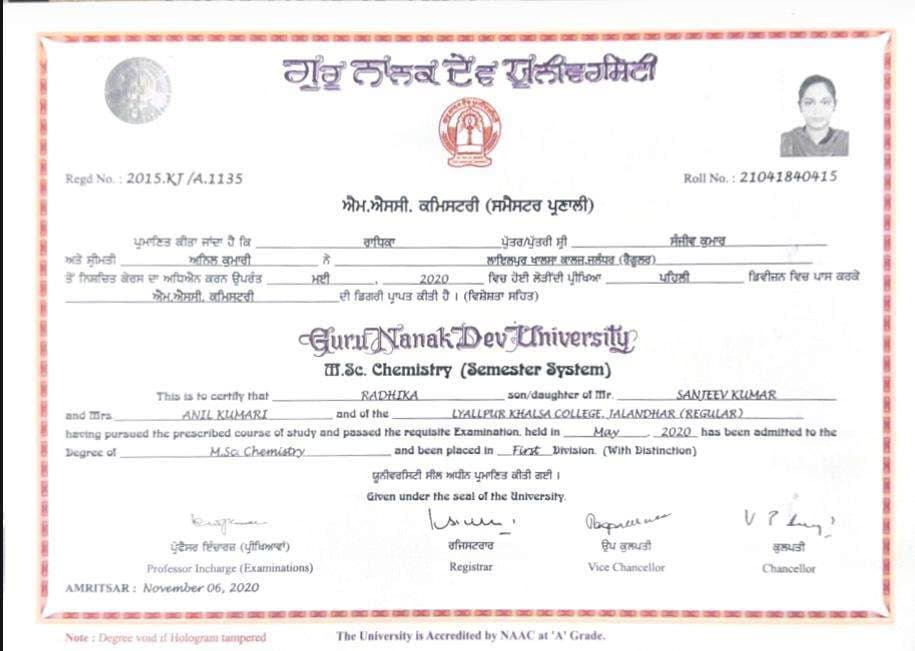
Radhika graduated from Guru Nanak Dev University

Specialities of your chemistry tutor

State-Specific Standards (USA)

Test prep strategies

New Zealand Curriculum - NZC (NZ)
Review sessions

Australian Curriculum (AU)

Chemistry experiments
Career guidance

GCSE (UK)
Personalized learning plans

International Baccalaureate (IB)

A-Levels (UK)
 CoTutor
AI modules
Summary
Podcast
Quiz
Learnings
Flashcard
Spotlight
Zero Risk Guaranteed
15-days refund
Free tutor swap
No cancel fee
1-yr validity
24/7 support
Types of learners for chemistry class

Elementary School students

Anxiety or Stress Disorders
College students
High School students
Middle School students

ASD

Home schooled
Your chemistry tutor also teaches

Chemistry
Organic Chemistry
Chemical Reactions
Physical Chemistry
Inorganic Chemistry
Atomic Structure

Chemistry concepts taught by Radhika
The Student and Tutor reviewed key Chemistry concepts, including limiting reagents, molarity calculations, and the Valence Shell Electron Pair Repulsion (VSEPR) theory. They practiced applying VSEPR theory to predict molecular geometry and bond angles. The plan is to continue with VSEPR questions and introduce the resonance topic in the next class.
Limiting Reagents
Molarity Calculation from Density
VSEPR Theory: Impact of Lone Pairs on Bond Angles
VSEPR Theory: Predicting Molecular Geometry
Dilution Equation (M₁V₁ = M₂V₂)
The Student and Tutor practiced solving chemistry problems related to limiting reagents and stoichiometry. They worked through examples involving molarity calculations, identification of limiting reagents, and conversion of moles to mass of products. A similar problem was assigned as homework for the Student to complete before the next session.
Understanding Precipitates
Stoichiometric Product Yield & Unitary Method
Molarity and Mole Calculations
Limiting Reagent
Calculating Molar Mass
The Student and Tutor reviewed fundamental chemistry concepts, including Lewis structures and different types of chemical bonds (ionic, covalent, and coordinate covalent bonds). The session introduced and applied VSEPR theory to predict molecular shapes, with the Student working through examples. They also briefly re-examined a complex stoichiometry problem from a previous class and agreed to continue practicing similar problems in the next session.
Coordinate Covalent Bonds (Dative Bonds)
Lewis Acids and Bases
Properties of Coordinate Covalent Compounds
VSEPR Theory: Predicting Molecular Shapes
Calculating Steric Number and Determining Molecular Geometry
The Student and Tutor engaged in an extensive practice session covering quantitative chemistry concepts, including calculations related to moles, molecules, molarity, average atomic mass from isotopes, and empirical/molecular formulas. They also began working on a stoichiometry problem, which will be revisited in the next class along with limiting reagents before introducing new topics.
Molarity (M)
Mole Concept & Avogadro's Number
Stoichiometry: Mass-Molarity Calculations
Empirical and Molecular Formula
Average Atomic Mass of Isotopes
Student and Tutor had an introductory chemistry lesson focusing on thermochemistry. They reviewed fundamental concepts such as energy forms, the law of conservation of energy, state functions, endothermic/exothermic processes, internal energy, and enthalpy. The session concluded with a detailed breakdown of a multi-step calorimetry problem to calculate total energy change, with a plan to address more assignment questions in future classes.
Thermochemistry and Energy Fundamentals
Kinetic and Potential Energy
System
Surroundings
and State Functions
Endothermic and Exothermic Processes
Internal Energy (ΔE) and Work (W)
Enthalpy (ΔH)
The Student and Tutor engaged in a comprehensive review of numerical problems in Chemistry. They covered various concepts including molecular mass, mass percentage, empirical formula, limiting reagents, isotopic mass, parts per million, and molarity calculations. The Student requested to continue with revision on these topics in the next session to ensure full understanding.
Molecular Mass Calculation
Mass Percent of Elements
Empirical Formula Determination
Limiting Reagent
Average Atomic Mass (Isotopic Mass)
PPM to Mass Percentage & Molarity
Tools & techniques used by chemistry tutor

Practice worksheets
Digital Note taking
Interactive 3D models

Quizzes

Digital whiteboard

Chemistry tutors on Wiingy are vetted for quality
Every tutor is interviewed and selected for subject expertise and teaching skill.
