
Aakriti Mehrotra
Expert Chemistry Tutor | Concept Clarity, Problem Solving, Homework Help & Exam Support


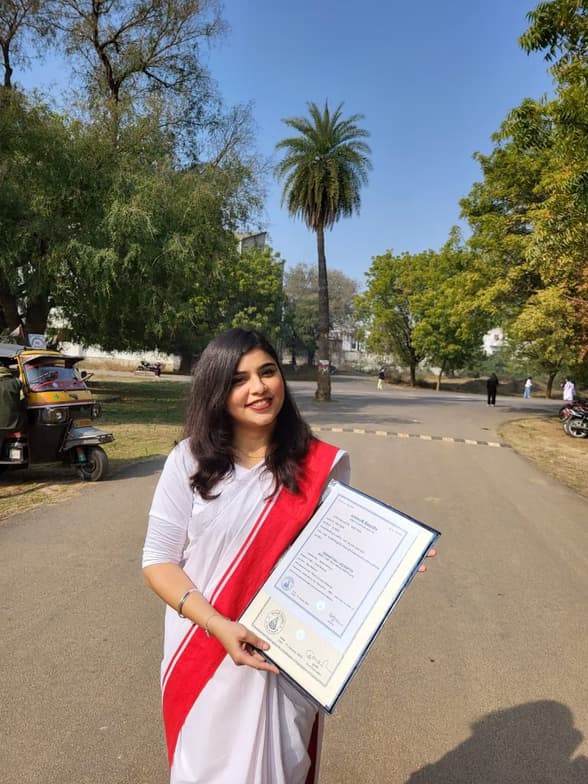




Show all photos
Aakriti Mehrotra
Masters degree
/ 55 min
Aakriti Your chemistry tutor
I am a dedicated Chemistry educator and Subject Matter Expert with a Master’s degree in Chemistry and more than three years of teaching experience. I have taught students from diverse countries and academic curricula, helping them build a strong conceptual foundation in Chemistry. My expertise spans Physical, Organic, Inorganic, Analytical Chemistry, and Biochemistry, enabling me to guide students through a wide range of topics with clarity and precision. My teaching approach focuses on simplifying complex concepts, strengthening fundamentals, and developing structured problem-solving skills. I support students with conceptual understanding, homework assistance, assignments, and exam preparation while ensuring they understand the logic behind every solution. I use interactive and student-centered teaching methods, encouraging questions and active participation. Using digital tools such as a pen tablet, laptop, or writing tablet, I explain concepts visually and solve problems step-by-step, creating an engaging learning environment where students gain confidence and a deeper understanding of Chemistry for long term academic success and growth.
Meet Aakriti
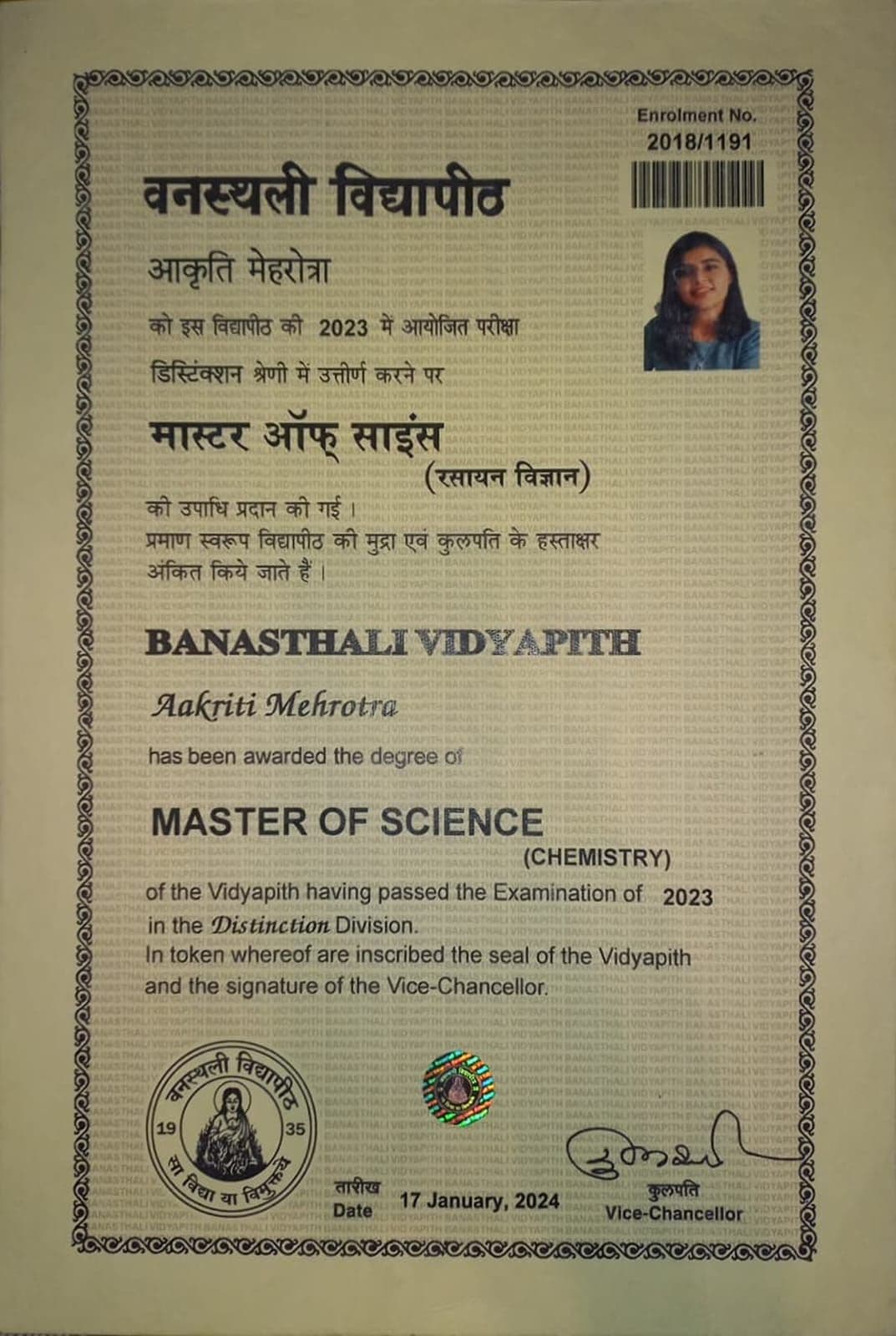
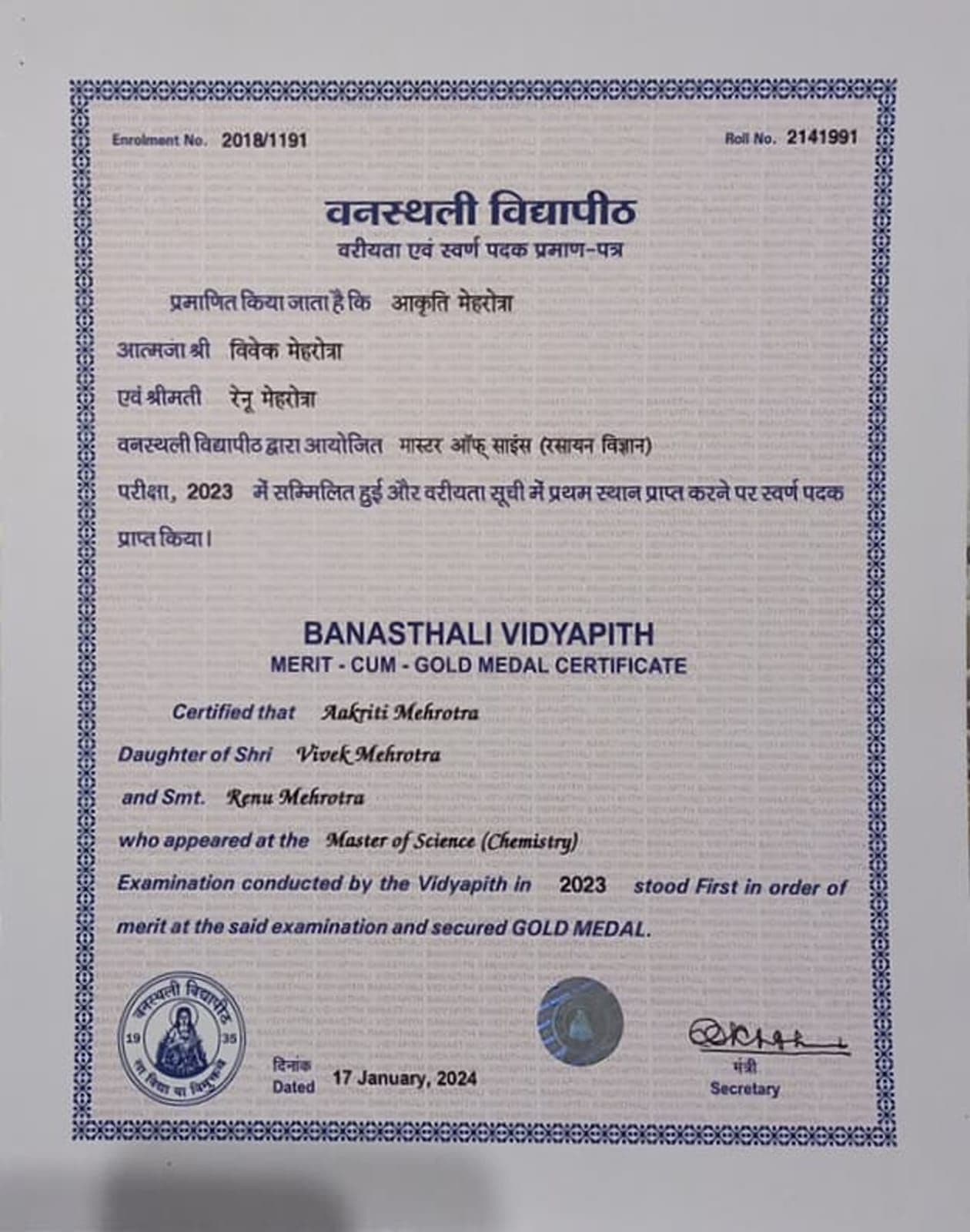
Aakriti graduated from Banasthali Vidyapith
Specialities of your chemistry tutor

Homework help

Chemistry experiments

Common Core State Standards - CCSS (USA)

Australian Curriculum (AU)

Chemistry lab skills

Visual learning

New Zealand Curriculum - NZC (NZ)

Advanced Placement (AP) Program (USA)

International Baccalaureate (IB)
Real world application

Provincial-specific curriculum (CA)
 CoTutor
AI modules
Summary
Podcast
Quiz
Learnings
Flashcard
Spotlight
Zero Risk Guaranteed
15-days refund
Free tutor swap
No cancel fee
1-yr validity
24/7 support
Types of learners for chemistry class

Elementary School students
None of the above
Middle School students
College students
High School students
Your chemistry tutor also teaches
Chemistry
Organic Chemistry
Chemical Reactions
Physical Chemistry
Inorganic Chemistry
Analytical Chemistry

Chemistry concepts taught by Aakriti
The Tutor and Student reviewed the definition of pH, its relationship with pOH, and the water ion product constant (Kw). They practiced calculating hydronium and hydroxide ion concentrations from given pH values and vice versa, and determined whether solutions were acidic or basic. The session also included problems on preparing solutions of specific concentrations and pH.
pH Definition and Scale
The pH and pOH Relationship
Water Ion Product Constant (Kw)
Monoprotic vs. Diprotic Acids
Calculating Molar Mass and Grams
The Tutor and Student reviewed solubility concepts using solubility graphs, applying them to calculate solute amounts and temperatures. They also touched upon gas solubility, solution saturation, and calculations involving molarity and gas laws, with plans for further practice on gas laws.
Solubility and Temperature
Interpreting Solubility Graphs
Molarity and Solution Preparation
Ideal Gas Law at Standard Temperature and Pressure (STP)
The tutor and student reviewed gas laws and their application to determine molecular mass using the ideal gas law. They then practiced calculations involving solution dilution, including finding final molarity, final volume, and the volume of solvent added. The session concluded with exercises on calculating percentage by mass and by volume.
Percentage Composition (Mass and Volume)
Ideal Gas Law and Molecular Mass Determination
Dilution Formula: M₁V₁ = M₂V₂
The student received a trial lesson focusing on organic chemistry concepts, including nucleophilic substitution reactions (SN1, SN2), the Wittig reaction, oxidation-reduction, and Grignard reagents. The tutor guided the student through solving specific problems from their homework assignment, explaining reaction mechanisms and reagents. The session concluded with administrative discussions about scheduling and platform features.
Nucleophilic Substitution Reactions (SN1 & SN2)
Wittig Reaction
Grignard Reagents
HSAB Principle (Hard and Soft Acids and Bases)
The tutor guided the student through problems involving solution saturation, emphasizing the comparison of actual solute concentration to maximum solubility. They also reviewed the definitions and calculations for molarity and molality, and the student practiced applying these concepts to solve numerical problems. The next steps involve memorizing relevant formulas and values for future assessments.
Solute
Solvent
and Solution
Saturated vs. Unsaturated Solutions
Solubility Constant and Maximum Solubility
Density and Mass-Volume Conversion
Molarity vs. Molality
Calculating Moles and Molarity
The tutor and student worked through several quantitative chemistry problems, applying stoichiometry and the ideal gas law to calculate volumes, masses, and moles of reactants and products. They practiced balancing equations, converting units, and using molar masses and gas constants to solve for unknown quantities, with a focus on predicting gas volumes evolved from chemical reactions.
Balancing Chemical Equations
Ideal Gas Law (PV=nRT)
Stoichiometry and Mole Ratios
Temperature Conversions (Celsius to Kelvin)
Tools & techniques used by chemistry tutor

Quizzes
Digital Note taking

Digital whiteboard
Video conferencing

Chemistry tutors on Wiingy are vetted for quality
Every tutor is interviewed and selected for subject expertise and teaching skill.