
Dr. Theertha Nair A
Personalized one-to-one online Mathematics classes designed to strengthen fundamentals and develop interest towards the subject.


Show all photos
Dr. Theertha Nair A
Doctorate degree
/ 55 min
Dr. Theertha - Know your tutor
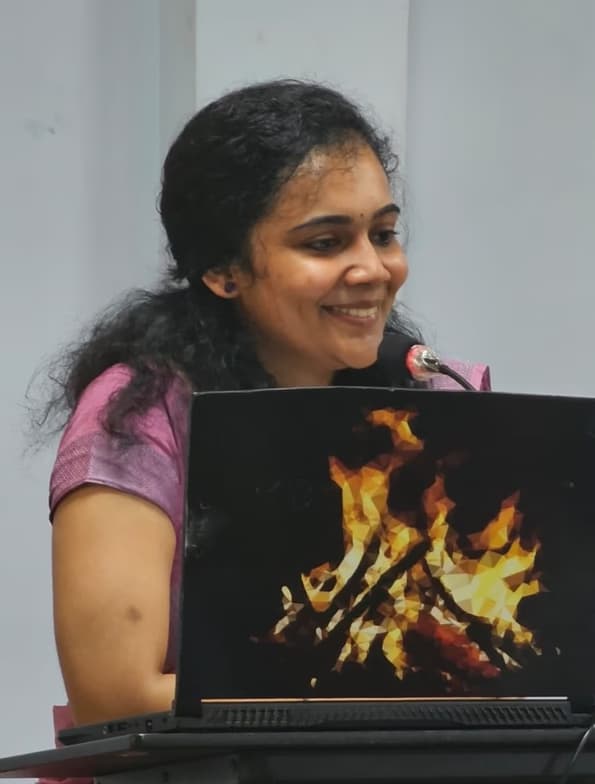
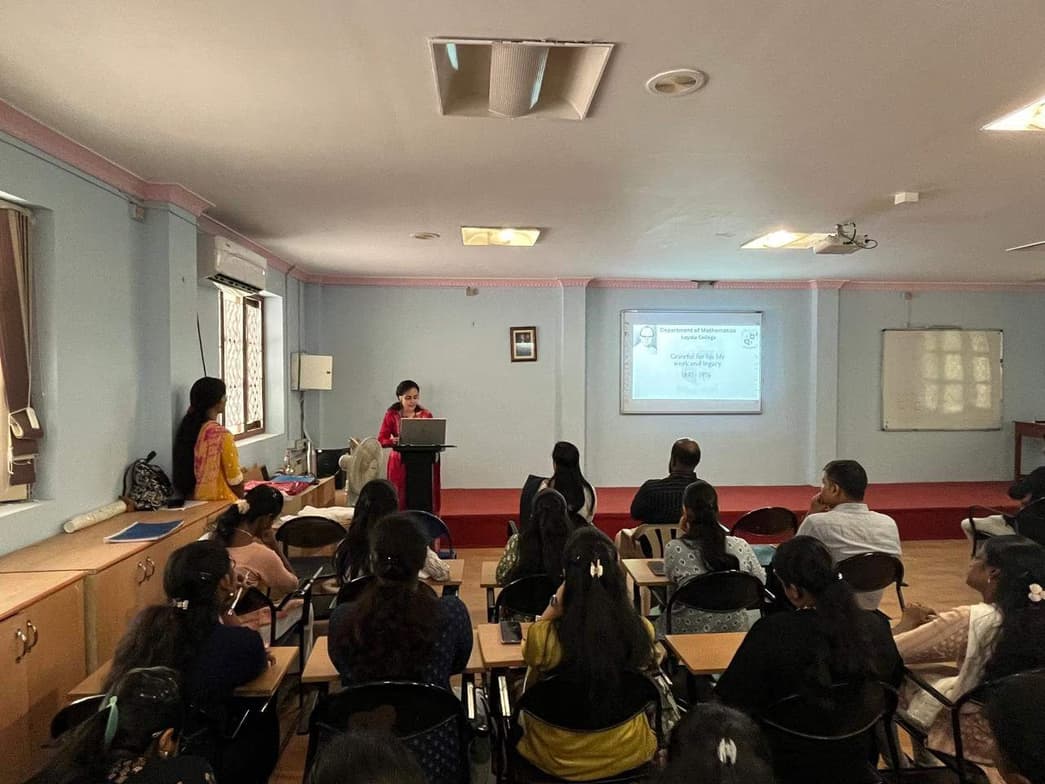
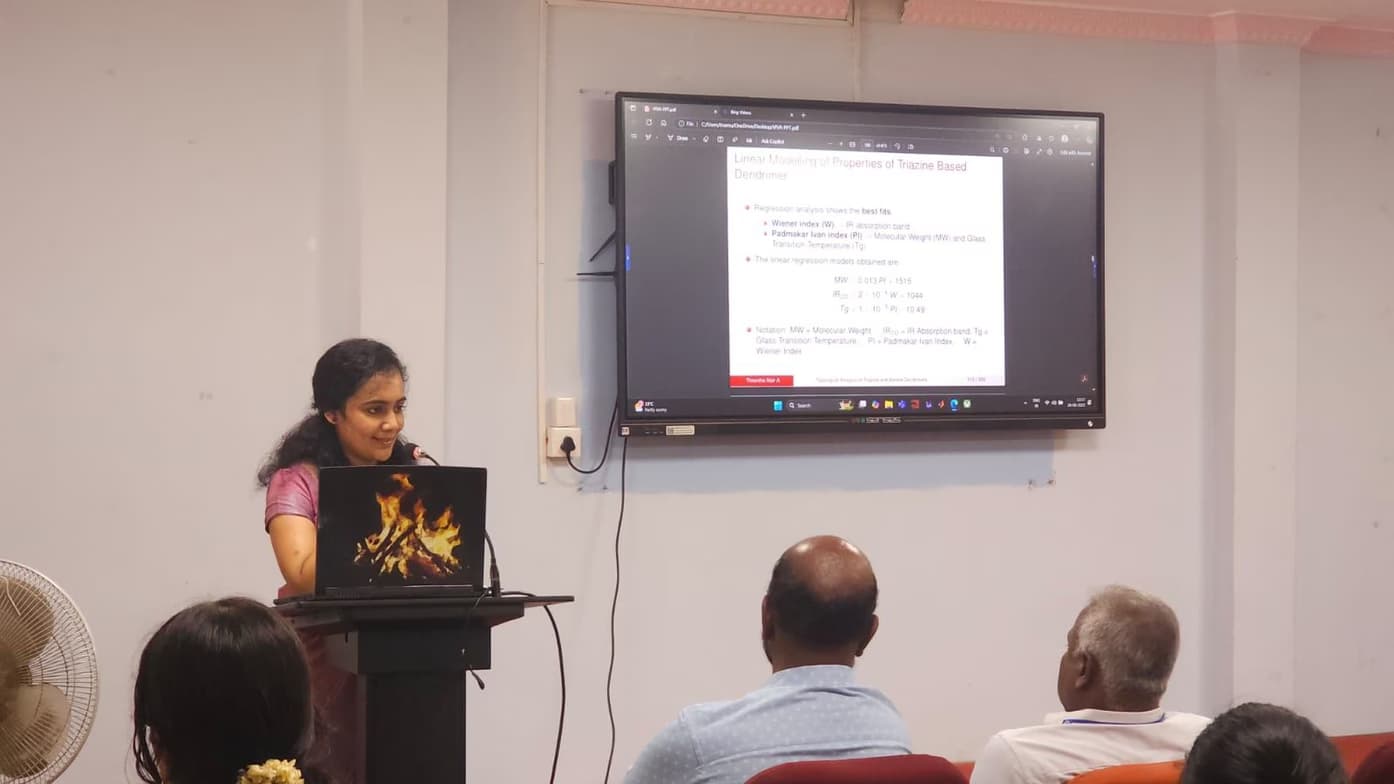
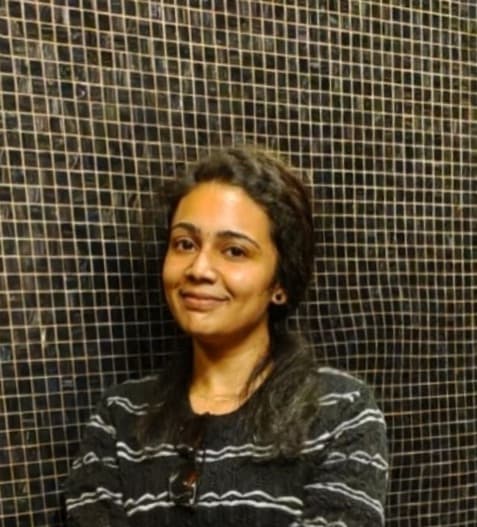
I am Dr. Theertha Nair A. I am currently working as a college lecturer in Kerala, and teaching has always been part of my life. Both my parents are teachers, and from childhood I grew up watching them, slowly dreaming of becoming a college teacher one day—and here I am. While teaching in college, I met many students who struggled even with basic concepts, not because they lacked ability, but because their foundations were weak. I don’t blame students or teachers; both share that responsibility. For me, mathematics is not just numbers—there is a beautiful story behind every concept. I believe teachers should help students see that story and fall in love with the subject. I may not change the world, but if I can make a small positive change for a small group of future learners, that itself is meaningful. And that is why I am here. I started learning maths from scratch and slowly grew into a Doctor of Mathematics, so I know the struggles well. In my class, everything is made to make sense. Instead of only asking “why”, I help students think “why not”. If you want to enjoy maths, understand it deeply, and build real confidence—not just learn formulas—this class is for you.
Meet Dr. Theertha
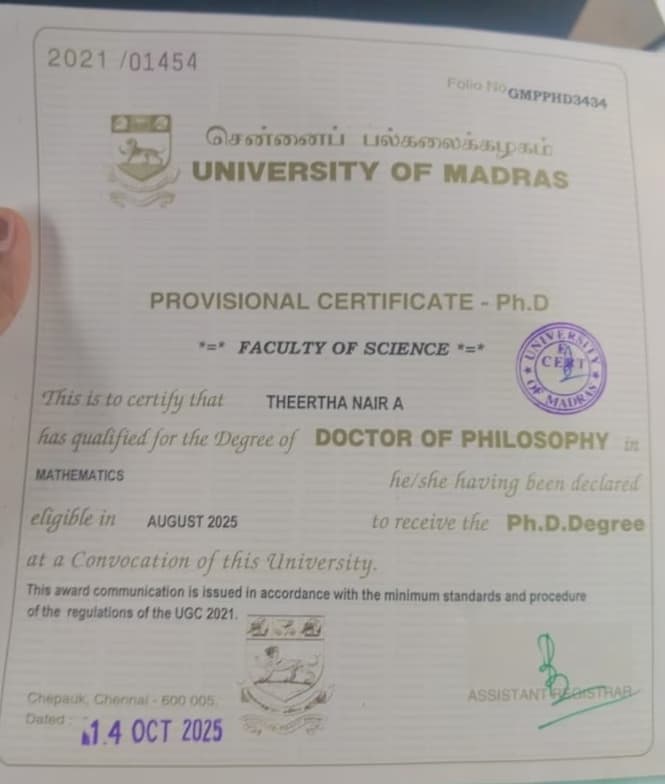
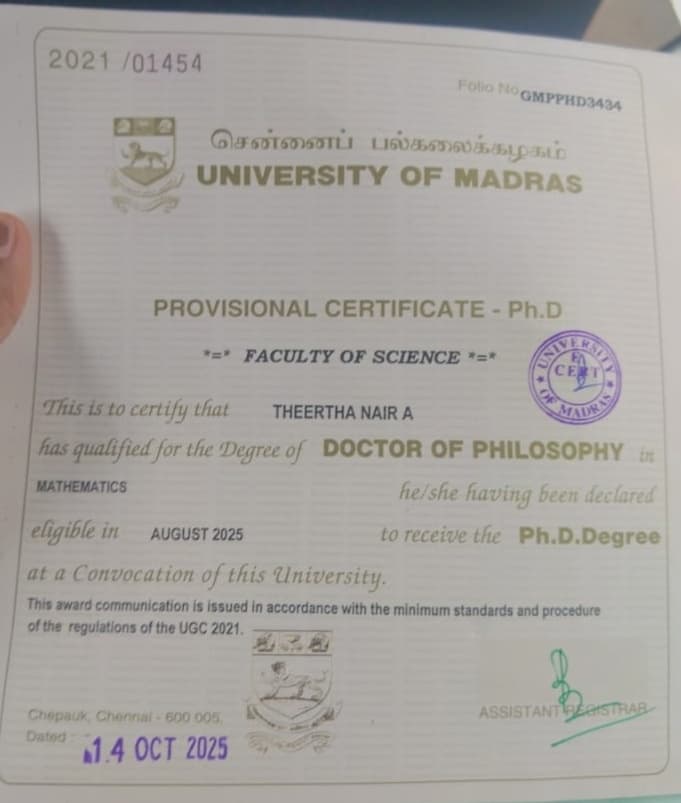
Dr. Theertha graduated from University of Madras
Specialities of your tutor

Math Tricks and Hacks

Problem Solving

Homework help

Practice Tests

Learning Plans
 CoTutor
AI modules
Summary
Podcast
Quiz
Learnings
Flashcard
Spotlight
Zero Risk Guaranteed
15-days refund
Free tutor swap
No cancel fee
1-yr validity
24/7 support
Student types for classes

None of the above
College students
Middle School students
Elementary School students
High School students
Class overview
I focus on building strong fundamentals from the very beginning, ensuring students truly understand concepts instead of memorizing formulas. I encourage curiosity and questions, helping students see the story behind every number, and guide them from asking “why” to thinking “why not.” My classes are designed to make learning enjoyable, develop real understanding, and inspire a lasting love for mathematics. Having taught over 200 students, I excel in adapting lessons to different learning levels, using interactive methods, examples from real life, and personalized guidance. I believe every student can excel when their fundamentals are strong, and I aim to build confidence, logical thinking, and problem-solving skills so students not only perform well in exams but also develop a genuine interest and passion for mathematics that lasts a lifetime.
Dr. Theertha also teaches

Algebra
Algebra 2
Arithmetic
Calculus
Calculus 2
Calculus 3

Mathematics concepts taught by Dr. Theertha
The session primarily focused on solving a diverse set of mathematics problems covering topics such as logic, algebra, number theory, set theory, logarithms, and inequalities. The Student practiced applying various mathematical concepts and problem-solving strategies, including the principle of contrapositives and inclusion-exclusion. As a follow-up, the Tutor will send a 20-question test on Saturday for the Student to complete.
Disproving Universal Claims
Algebraic Identities & Odd Number Properties
Contrapositive of Conditional Statements
Principle of Inclusion-Exclusion (for Counting)
Logarithm Properties
Modular Arithmetic & Properties of Squares
Absolute Value Inequalities (Triangle Inequality)
The session focused on solving various advanced mathematics problems, including infinite series, trigonometric function optimization, calculus applications for local extrema, arithmetic-geometric series summation, and logarithmic inequalities. The Student actively worked through these problems, receiving guidance on algebraic manipulation and conceptual application. For future study, the Student requested to focus on proof-based questions in the next class, and the Tutor agreed to provide solutions for some of the more complex problems discussed.
Polynomial Function Reconstruction from Roots
Solving Logarithmic Inequalities via Quadratic Substitution
Finding Extrema (Max/Min) of Functions using Calculus
Summation of Series: Telescoping & GP Transformation
Algebraic Simplification for Function Optimization
Student and Tutor worked through several advanced calculus problems, focusing on applying the trapezium rule, evaluating definite integrals using substitution, and analyzing the accuracy of numerical integration methods. They also reviewed basic integration techniques, discussed properties of odd and even functions in integration, and tackled an integral involving a floor function. Two specific problems (9th and 11th) were identified for potential follow-up discussion or solution sharing.
Definite Integral Substitution & Dummy Variable Property
Integration of the Floor Function (⌊x⌋)
Area Under & Between Curves
Integral Properties for Function Types & Approximation Error
Trapezium Rule for Numerical Integration
The Student and Tutor worked through various advanced mathematics problems, covering definite integrals, infinite geometric series, geometry of tangent circles, and trigonometric series. They also practiced logical proofs by finding counter-examples and reviewed differentiation for finding tangent slopes. The remaining problems from the set are to be completed as follow-up work.
Definite Integrals: Modulus Functions & Translations
Trigonometric Product Series: tan Identities
Proving Inequalities: The `A - B > 0` Method
Trigonometric Series Summation: sin² Identities
Geometry: Radii of Mutually Tangent Circles
Manual Square Root Calculation: Long Division Method
Sum of Infinite Geometric Progressions
The Student and Tutor reviewed various graph sketching techniques for different types of functions, including logarithmic, trigonometric, exponential, rational, cubic, and implicit equations. They focused on identifying key features like symmetry, intercepts, asymptotes, and turning points. The session concluded with a discussion of the next chapter, Trigonometry, and the Tutor requested the Student to share the relevant material.
Graphing Logarithmic Functions: `y = log₁₀(x² - 4x + 5)`
Graphing Trigonometric Functions: `y = cos(4x)sin(x)`
Graphing Exponential Functions: `y = 2^(x² - 2x + 5)`
Advanced Graph Transformations: Sequential Reflections
Turning Points of Cubics (Non-Differential Method)
Rational Function Graphing: `y = (x² + 4) / ((x + 1)(x - 3))`
The session focused on various calculus problems, including finding functions from derivatives, solving differential equations, calculating areas enclosed by curves, and comparing definite integrals using inequalities. The Student actively practiced applying integration techniques and algebraic simplification. For follow-up, the Tutor assigned a test for Sunday, incorporating questions similar to TMUA paper one, covering topics discussed.
Antidifferentiation with Initial Conditions
Solving Differential Equations via Substitution
Quadratic Factorization: Splitting the Middle Term
Definite Integrals and Dummy Variables
Area Enclosed by Curves
Comparing Definite Integrals Using Inequalities
Teaching tools used by tutor

Assessment

Presentations

Graphing Tools

Lesson Planner

Digital whiteboard
Interactive lessons

Mobile joining

Parent feedback

Open Q&A

Note taking

Weekend lessons

Math tutors on Wiingy are vetted for quality
Every tutor is interviewed and selected for subject expertise and teaching skill.
