
Rebekah Stickler
"The violin is the most human of all instruments," ~Louisa May Alcott Let's explore the world of music!




Show all photos
Rebekah Stickler
Bachelors degree
/ 55 min
Rebekah - Violin teacher
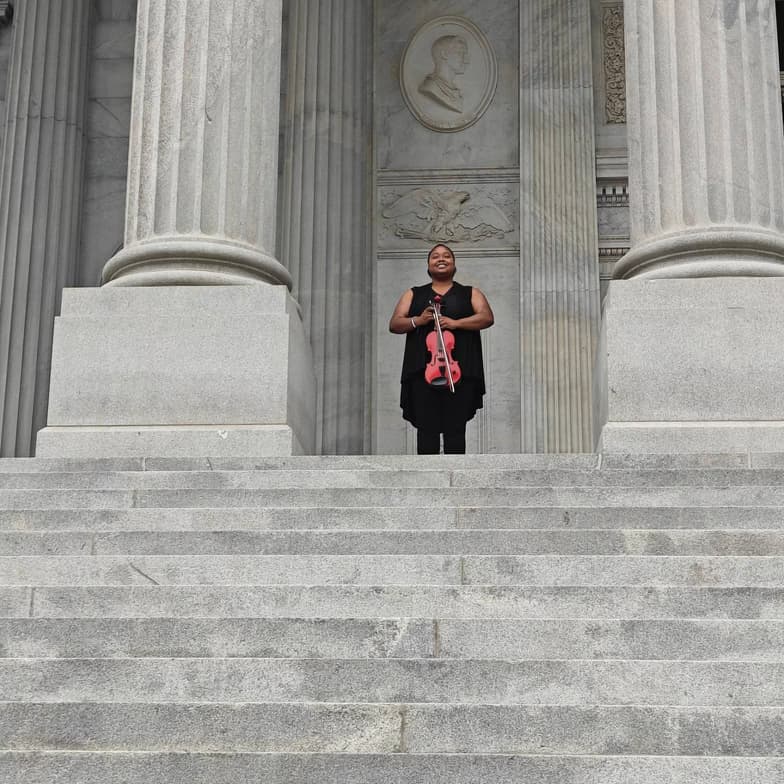
HI! I am so excited to meet you! My name is Rebekah, or you can call me Miss Rebekah. I have over 25 years of experience and a Bachelor of Music degree from Montclair State University, NJ. Excited to learn? Well, I am excited to teach you! I have taught many various styles of music, from Classical to Pop, Rock, Celtic, fiddle, and more. The foundation of all is classical, and we can go from there. My approach covers everything from bowing techniques to music theory and repertoire. I have taught ages 4-60 as well as all levels from beginner to advanced. I have prepared many for recitals, auditions, shows, and more. One of my favorite things is when a student gets a concept they have been working really hard on, and the excitement that comes over them is amazing! Whether you want to become a music major or just play for fun, maybe it's been a lifelong dream, or you're just starting, we will embark on this journey together to bring your dreams to life!
Meet Rebekah
Rebekah graduated from Montclair State university


Expertise of the violin teacher

Reading Music & Sight-Reading

Ear training
Posture and Hand Position
Finger Placement and Scales
Bow Techniques
Scales and Arpeggios
Rhythm and Timing
 CoTutor
AI modules
Summary
Podcast
Quiz
Learnings
Flashcard
Spotlight
Zero Risk Guaranteed
15-days refund
Free tutor swap
No cancel fee
1-yr validity
24/7 support
Student types for violin lessons

Violin for intermediate
Violin for beginners
Violin for kids
Violin for advanced
Violin for adults
Violin lessons overview
My teaching style focuses on expressive and rhythmic accuracy while building a classical foundation. One of my favorite tools to use while teaching is the METRONOME! I love it. When I was younger, I was not so sure of it, but as I grew, I learned its value! My practice became more accurate; it was not a chore but a joyful thing to do. I don't always have a lot of time. But with a metronome, you use the time you have very wisely and many times accomplish more in a short practice. My approach is fun and engaging and ensures step-by-step mastery for all students, ranging from beginner to advanced levels. No student is the same. You are not a cookie-cutter! I take my time, yet still have goals for the student to strive for. I follow a structured curriculum and blend traditional methods with modern teaching methods. The key for me is listening; I have moved and shifted my teaching over the 200+ students I have had throughout the years. I have taught many autistic students of varying levels! Never stop learning, shifting, and creating new sounds!
Types of violin lessons

Violin
Classical Violin
Electric Violin
Acoustic Violin
Baroque Violin
Fiddle Violin

Violin concepts taught by Rebekah
The Student demonstrated significant progress on their current violin piece, playing it through without pauses and actively correcting intonation. The Tutor then introduced a new violin piece, "Red Wing," explaining its musical structure and suggesting initial practice methods. A major part of the session was dedicated to advising the Student on the process of purchasing a new violin, including financial considerations, instrument types, and strategies for testing instruments.
Violin Bow Materials & Maintenance
Refining Violin Technique: Intonation & Hand Grip
Introducing 'Red Wing' Fiddle Tune
Violin Instrument Upgrade & Selection
Understanding Pickups & Incomplete Measures
Student and Tutor focused on violin tuning, confirming the comfort and benefits of a correctly sized instrument. They practiced G, D, and A major scales and diligently worked on correcting the student's bow hold, including specific exercises for pinky and thumb placement. For homework, the Tutor will send recommendations for ABRSM books (grades 2-5), a comprehensive scale book, and a site-reading book.
Violin Tuning & String Management
Strategic Practice & ABRSM Progression
Bow Placement & Articulation
Major Scale Practice & Finger Patterns
Precision Bow Hold Techniques
Instrument Sizing & Comfortable Posture
The Student and Tutor worked extensively on fundamental violin techniques, including left-hand posture, thumb position, wrist alignment, and bow hold. They practiced scales and a musical piece, with a strong focus on reducing tension in both hands to improve sound quality. The Student is to inform the Tutor of upcoming absence dates for scheduling adjustments.
Left-Hand Thumb & Wrist Posture
Left-Hand Fingerboard Contact
Relaxed Bow Hold & Finger Spacing
Bow Control and Sound Quality
Mind-Body Connection & Relaxation
Student and Tutor focused on fundamental violin techniques, addressing challenges with intonation, finger placement, and instrument hold. They practiced specific notes on the G string, utilized silent and visual practice methods, and refined posture and bow technique. The student is tasked with practicing the current piece, 'Arkansas Traveler,' through to completion for the next session, integrating the new techniques, and considering adjustments to their chin rest and music stand.
Left-Hand Finger Retention & Spatial Memory
Optimal Violin Posture & Chin Rest Fit
Cultivating Left-Hand Relaxation & Wrist Flexibility
Precision Intonation with a Tuner
Strategic Practice Techniques for Accuracy & Flow
The Student and Tutor focused on improving violin technique, specifically addressing left-hand posture to alleviate thumb pain and refining bow usage for a cleaner sound on the A string. They practiced open strings and fingered notes, with the Tutor providing detailed feedback on hand positioning and bowing. Homework for the next session includes practicing the D and A scales, and continuing with a previously learned piece.
Optimizing Bow Length and Arm Movement
Ergonomic Left-Hand Thumb Placement
Left Wrist and Forearm Alignment
Achieving Consistent A String Sound
Importance of Breathing and Relaxation in Playing
The Student and Tutor focused on violin scale practice, including G, D, A, and B major, with an emphasis on precise finger placement, wrist posture, and tuning adjustments. They also began a new piece, concentrating on correctly identifying key signatures and applying finger patterns. The Student was assigned to complete the current piece, practice scales with triplet rhythms, and refine wrist positioning for the next session.
Violin String Tuning & Adjustment
Major Scale Technique & Posture
Key Signatures & Finger Pattern Application
Triplet Rhythm Practice
Violin Instrument Damage & Repair Protocol
Applying Learned Skills to Repertoire
Teaching tools used in vioin classes
Metronome Apps
Violin Tuner Apps
PDF Sheet Music Libraries
Engaging violin lessons

Parent feedback

Mobile joining

Record lessons

Open Q&A

Weekend lessons

Violin teachers on Wiingy are vetted for quality
Every tutor is interviewed and selected for subject expertise and teaching skill.
