
Rithika Rushendra
Learn Java and Python with a supportive tutor with a background in computer science!


Show all photos
Rithika Rushendra
Bachelors degree
/ 55 min
About your coding tutor - Rithika
I am a final-year Bachelor of Computer Science student with nearly a decade of teaching experience, including close to ten years teaching computer science and programming concepts. My long-standing involvement in education has allowed me to develop a deep understanding of how students learn technical material, especially in areas that are often perceived as difficult or intimidating, such as coding and problem-solving. Over the years, I have worked with students of varying ages, backgrounds, and skill levels, helping them build confidence and competence in technology through structured, supportive instruction. My primary teaching focus is computer science, with particular expertise in Python and Java. I teach these languages not just as tools for writing code, but as frameworks for developing logical thinking, algorithmic reasoning, and effective problem-solving strategies. When teaching Python, I emphasize readability, foundational programming concepts, and real-world applications such as data manipulation, automation, and basic software development. With Java, I focus on object-oriented programming principles, program structure, and understanding how larger systems are designed and maintained. In both cases, I aim to help students understand why code works, not just how to write it.
Coding tutor specialities

Project help

Homework help

Code Review

Assignment help

Exam prep
 CoTutor
AI modules
Summary
Podcast
Quiz
Learnings
Flashcard
Spotlight
Zero Risk Guaranteed
15-days refund
Free tutor swap
No cancel fee
1-yr validity
24/7 support
Learner types for coding classes

Coding for kids
Coding for adults
Coding for intermediate
Coding for beginners
Coding class highlights
My teaching methodology is centered on clarity, adaptability, and building genuine understanding rather than rote memorization. I believe that effective learning in technical subjects, especially computer science, comes from helping students understand why concepts work before expecting them to apply them independently. From the beginning, I focus on creating a supportive learning environment where students feel comfortable asking questions, making mistakes, and exploring ideas without fear of judgment. This foundation is essential for subjects like coding, where trial and error is a natural and necessary part of the learning process. A core component of my methodology is breaking complex concepts into smaller, manageable steps. Programming concepts can quickly become overwhelming if introduced all at once, so I scaffold learning by introducing ideas gradually and reinforcing them through repetition and practical examples. Each new topic builds on previously learned material, ensuring students have a strong foundation before moving forward. I frequently check for understanding and adjust the pace of lessons based on the student’s comfort level, ensuring learning remains steady and effective rather than rushed.

Expert in debugging code
Breaks down coding issues into manageable steps.

100% on-time college submissions
Students meet deadlines with tutor support.

Interactive debugging sessions
Students debug and improve their own code in real-time.
Rithika - Coding tutor also teaches

Coding for kids
Java
Python

Coding concepts taught by Rithika
The Student and Tutor reviewed previously assigned homework before commencing the Grade 6 mathematics curriculum, starting with place value concepts. They practiced identifying place values, converting between standard and expanded forms, and writing numbers from word form. The session ended with an interactive review game, and the next class will focus on integers.
Understanding Place Value
Expanded Form of Numbers
Standard Form of Numbers
Converting Word Form to Standard Form
The Student and Tutor practiced dividing fractions, reinforcing the 'keep, change, flip' method through various practice problems. They also discussed and outlined the upcoming Grade 6 mathematics curriculum, including topics such as integers, rounding numbers, and basic geometry, and assigned related homework for continued practice.
Dividing Fractions Using the Reciprocal Rule
Understanding the Reciprocal of a Fraction
Performing Fraction Multiplication
Trusting Your Mathematical Intuition
The Student and Tutor reviewed homework on adding and subtracting fractions, then introduced and practiced multiplying fractions. A significant portion of the session was dedicated to understanding and applying techniques for reducing fractions to their lowest terms, including specific divisibility rules. The Student will be assigned homework on multiplying fractions, and the next session will focus on division of fractions.
Essential Rules for Fraction Simplification
Reducing Fractions to Lowest Terms
Multiplying Fractions
The session focused on a detailed review and practice of adding fractions, with a strong emphasis on finding the lowest common multiple (LCM) for denominators. The Student worked through various examples, both guided and independently, to solidify their understanding of fraction conversion and addition. Homework was assigned, consisting of several worksheets covering both fraction addition and an introduction to fraction subtraction.
Converting Improper Fractions to Mixed Numbers
Finding the Lowest Common Multiple (LCM)
Adding Fractions with Unlike Denominators
The tutor and student worked on applying algebraic expressions to solve word problems involving discounts and multi-step calculations. They also practiced decimal division and fraction subtraction, with the tutor providing targeted instruction and exercises to reinforce these mathematical skills.
Solving Word Problems with Discounts and Multiple Items
Calculating Unit Price for Word Problems
Subtracting Fractions with Unlike Denominators
The Student and Tutor reviewed fundamental mathematical concepts including algebra, Bedmas (order of operations), and rounding large numbers. The Student practiced solving various problems in each area, reinforcing the application of inverse operations and rounding rules. The Tutor assigned additional worksheets on related topics as homework, encouraging the Student to bring any questions to the next class.
Algebraic Equations: Opposite Operations
BEDMAS: Order of Operations
Rounding Whole Numbers to Place Values
Approach & tools used by coding tutor

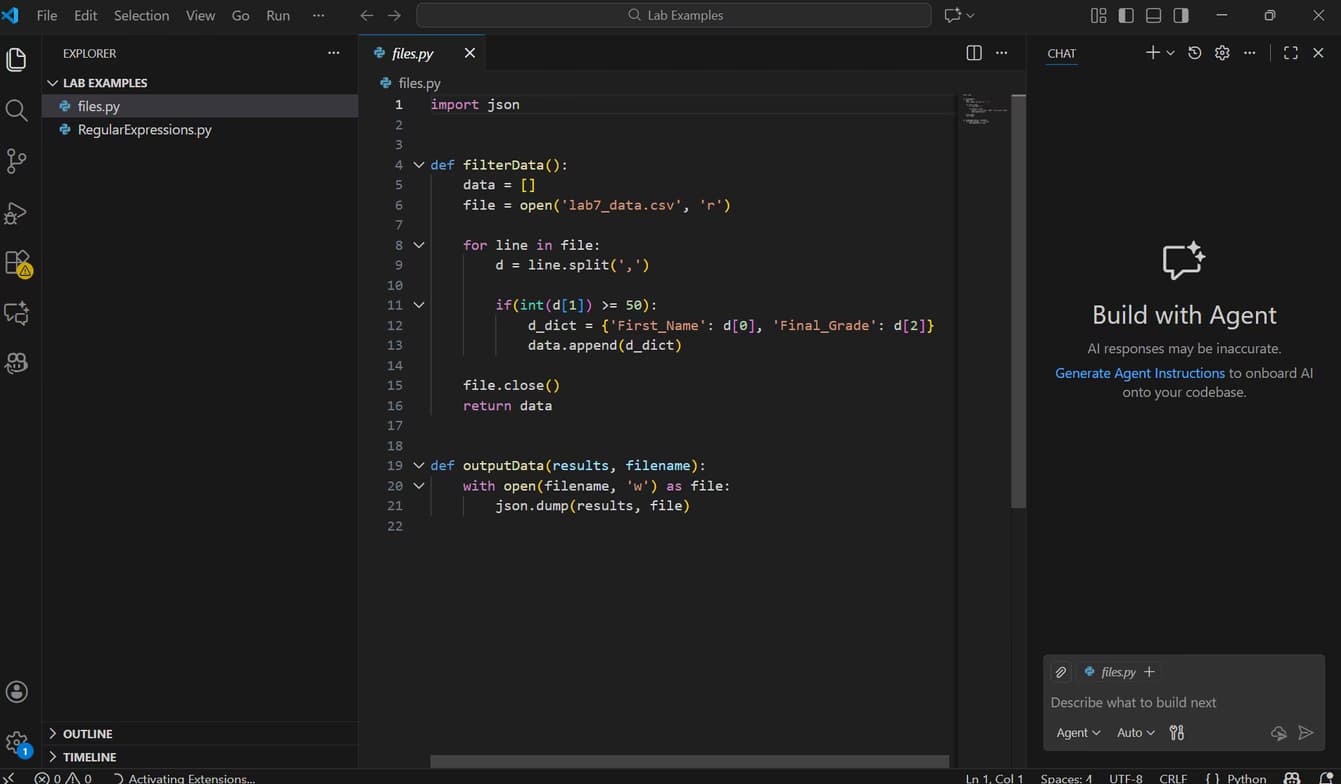
Visual Studio Code
Hands-on coding classes

Pets are welcomed

Weekend lessons

Mobile joining

Note taking

Parent feedback

Programming tutors on Wiingy are vetted for quality
Every tutor is interviewed and selected for subject expertise and teaching skill.
