
Japs Cunanan
Experienced tutor helping for grade improvement



Show all photos
Japs Cunanan
Bachelors degree
/ 55 min
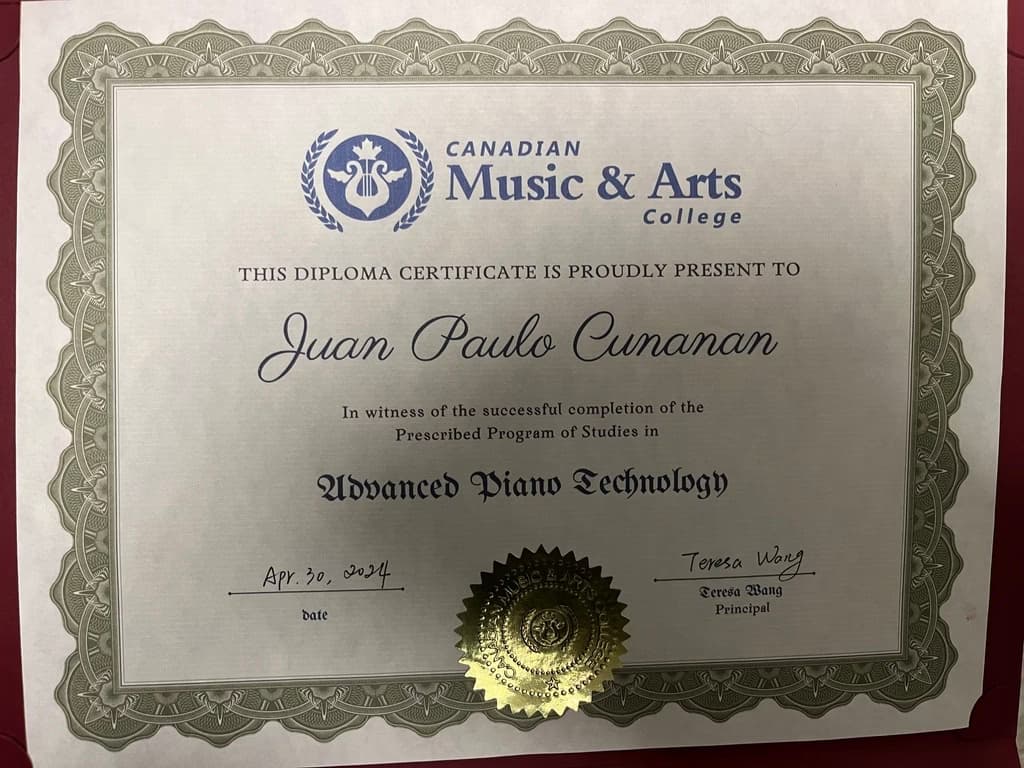
Japs graduated from St. Paul University


Your music teacher expertise

Rock

Jazz

Pop

Classical
 CoTutor
AI modules
Summary
Podcast
Quiz
Learnings
Flashcard
Spotlight
Zero Risk Guaranteed
15-days refund
Free tutor swap
No cancel fee
1-yr validity
24/7 support
Learner types for music lessons

Music for advanced
Music for beginners
Music for adults
Music for intermediate
Types of music lessons

Music Production
Music Composition
Sight-Reading
Digital Audio Workstation
Music Mixing
Sound Engineering

Music concepts taught by Japs
The Student and Tutor engaged in a piano lesson covering foundational music theory and practical application. They reviewed chord inversions, including root, first, and second positions, and practiced identifying melody, harmony, and bass notes. The Student applied these concepts to playing specific chords and a section of a song, while also discussing strategies for using online resources for self-study and practicing new pieces.
Personal Responsibility in Practice
Chord Inversions: Redefining the Bass
Chord Structure: Intervals and Alterations
"Over Chord" Notation for Inversions
Strategies for Music Learning & Performance
The Student and Tutor practiced piano techniques, including rhythm maintenance for an existing song, and effective sheet music management. They commenced learning chords for a new piece, "Girl from Ipanema," covering F major 7, G7, G minor 7, and G♭7♭5. The Student was assigned to practice these new chords and continue with their current song.
Understanding Tied Notes and Bar Lines
Sheet Music Organization for Seamless Play
Chord Voicing & Hand Distribution
Playing with Backing Tracks for Timing
Strategic Practice Techniques
Advanced 7th Chords Introduction
The Student showcased a prepared piece, prompting the Tutor to offer advice on performance preparation and strategies for advanced song development. They explored detailed reharmonization techniques and practiced exercises to improve hand independence. The Tutor also provided guidance for future practice and study.
Strategic Performance Preparation
New Age Melody-Chord Voicing
Advanced Reharmonization Strategies
Cultivating Piano Hand Coordination
Enhancing Left-Hand Accompaniment
The Student and Tutor engaged in a piano lesson focused on improving playing technique and music theory. They practiced a specific song, where the Tutor corrected fingering, hand positions, and posture. Key academic topics included advanced note reading using lines and spaces, understanding and applying suspended chords (Dsus4), and correctly voicing chord inversions (C over G, C over E) to avoid clashes with the melody. The Student received a structured practice plan emphasizing repetitions and new chord voicings up to measure 12.
Advanced Note Reading: Staff Lines & Spaces
Chord Inversions & Voicings
Suspended Chords (Dsus4)
Efficient Practice: Identifying Repetitions & Breaking Down Pieces
Fundamental Finger Technique & Posture
The Student and Tutor focused on piano technique and song learning. The Student demonstrated new songs learned, and the Tutor provided detailed instruction on efficient fingering, left-hand chord voicings including the use of the fifth, and arpeggio techniques. The session concluded with the Tutor outlining a specific chord progression for the song "Pretty Baby" for the Student to practice.
Understanding Musical Fifths and Harmonics
Left-Hand Arpeggio Techniques
Performance Consistency & Dealing with Change
Identifying and Modifying Chords
Synchronizing Hands with Half-Time & Double-Time Practice
Efficient Piano Fingering Principles
The Tutor and Student revisited advanced piano techniques, focusing on comping, voicing, soloing, and reharmonization strategies in jazz and gospel styles. They discussed various chord voicings like open, closed, stride, and shell voicings, along with soloing techniques combining arpeggios and scales. The Tutor provided extensive recommendations for jazz artists and songs, encouraging the Student to study fake books and compare recorded versions with lead sheets to understand reharmonization.
Creative Reharmonization & Chord Play
Strategic Learning & Listening for Jazz Piano
Dynamic Soloing Techniques
Advanced Piano Voicings & Hand Roles
Teaching tools used in music classes

Ear Training Software
Looping Software

Recording Apps
Backing Track Libraries
Interactive music lessons

Record lessons

Chat for quick help

Pets are welcomed

Open Q&A

Mobile joining

Music teachers on Wiingy are vetted for quality
Every tutor is interviewed and selected for subject expertise and teaching skill.