
Evelyn Nguyen
Specialized Quantum Mechanics Tutor with Structured Approach and Personalized Teaching Style for You.
Loading...


Show all photos
Evelyn Nguyen
Bachelors degree
/ 55 min
Evelyn - your physics tutor
I'm Evelyn Nguyen, a passionate online tutor with a Bachelor's degree in Physics. Despite my less than 1 year of experience, I bring fresh perspectives to teaching Physics. My specialities include career guidance, personalized learning plans, and test prep strategies. I love simplifying complex subjects like Electromagnetism, Quantum Mechanics, and more for elementary to college-level students. Through visual aids and real-world applications, I make Physics experiments and lab skills engaging. Let's ace those Physics concepts together!
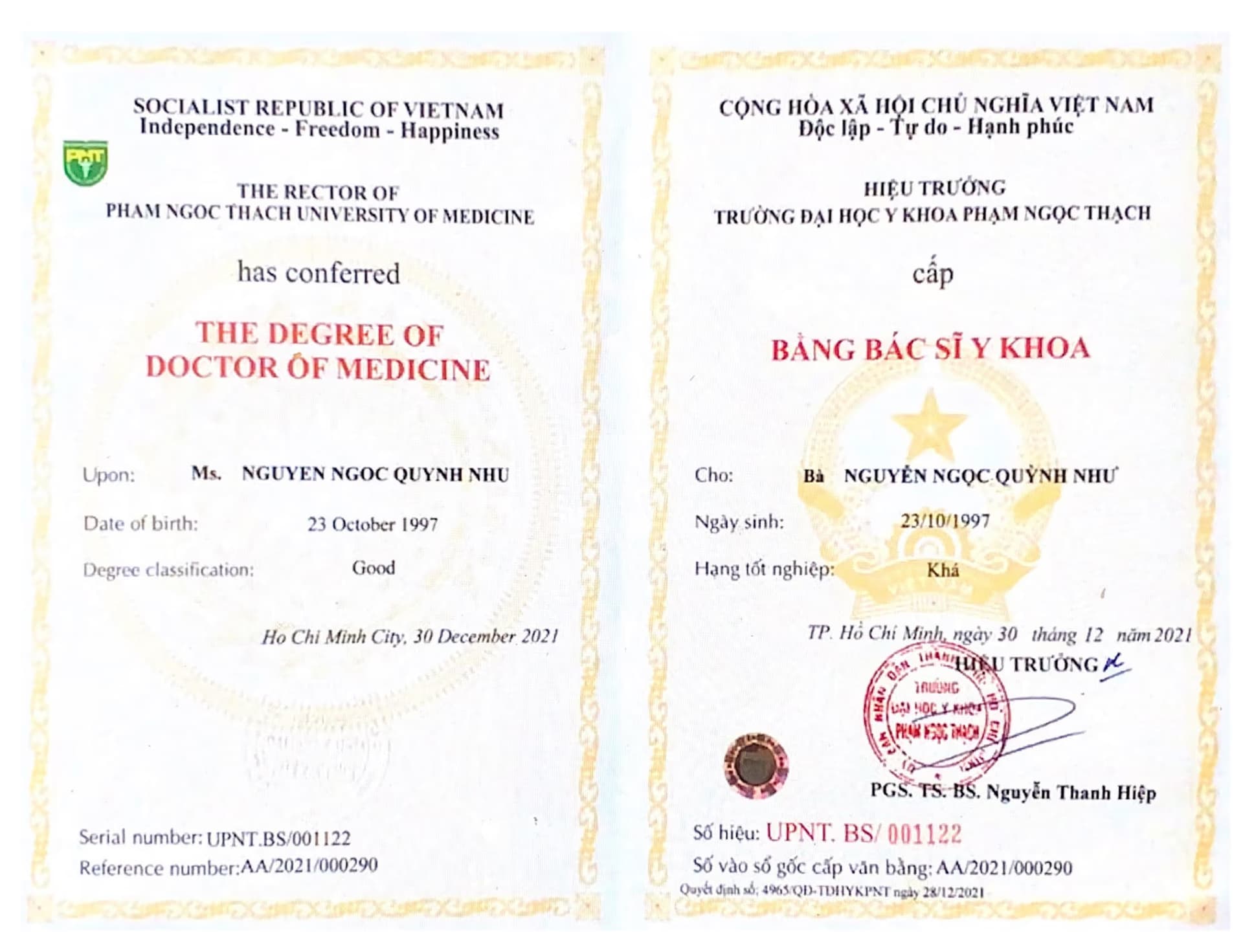
Evelyn graduated from Pham Ngoc Thach University of Medicine

Academic expertise of your physics tutor

Physics lab skills
Physics experiments
Review sessions
Real world application

Homework help
Student types for physics class

Middle School

ADHD

Anxiety or Stress Disorders
College
High School
Elementary School
Physics class snapshot
My tutoring approach blends structured learning with problem-solving to enhance conceptual understanding. I aim to inspire students, fostering a result-oriented mindset. Specializing in subjects like Electricity, Quantum Mechanics, and more, I leverage tech tools such as digital whiteboards and interactive diagrams for engaging online learning. By following diverse curricula like A-Levels (UK) and AP Program (USA), I cater to students from elementary to college levels, ensuring personalized tutoring that drives academic success.
Evelyn - Physics tutor also teaches

Nuclear Physics
Electromagnetism
Quantum Mechanics
Mechanics
Electricity
Magnetism

.svg)
15 days Refund
.svg)
Free Tutor Swap

Physics concepts taught by Evelyn
The Tutor and Student reviewed quiz questions, focusing on experimental design in biology and cell transport mechanisms. They covered passive and active transport, including diffusion, facilitated diffusion, primary and secondary active transport, and osmosis, with plans to continue practicing quiz questions.
Protein Function in Membrane Transport
Cellular Transport: Passive vs. Active
Surface Area to Volume Ratio in Diffusion
Experimental Question Analysis
The Tutor and Student discussed the challenges of applying biological knowledge in nursing studies, focusing on strategies for effective memorization and problem-solving using active recall and information classification. They planned to implement a quiz-based learning approach and structured anatomical study methods, with a focus on upper and lower extremity muscles for upcoming exams.
Active Recall with Question Banks
Classification and Organization for Anatomy
Iterative Learning and Feedback Loop
Bridging Lecture and Lab Material
The student and tutor engaged in a review of cell biology, focusing on key concepts relevant to AP exams. They practiced problem-solving strategies using a quiz-based approach, and discussed the importance of understanding experimental applications of cell biology principles, particularly concerning osmotic pressure and tonicity. The next session will continue this review.
Cellular Organelles: Structure and Function
Cell Membrane: Structure and Function
Osmolarity and Tonicity
Cell Size and Surface Area-to-Volume Ratio
Cell Theory Principles
The tutor and student reviewed physics concepts related to force resolution on inclined planes and circular motion. They practiced drawing free-body diagrams, applying trigonometric functions to find force components, and setting up equations for net force and acceleration. Homework assignments were provided for further practice.
Resolving Forces on Inclined Planes
Coordinate Systems and Vector Components
Centripetal Force and Circular Motion
The Student and Tutor reviewed circular motion, centripetal force, and apparent weight. The student practiced problems involving a swinging object and a bicycle turning, applying concepts of force components and kinematic equations. The tutor assigned additional problems related to centripetal force and forces on an inclined plane for the next session.
Centripetal Force
Apparent Weight
Newton's Second Law in Circular Motion
Work Done by a Force at an Angle
Analyzing Forces with Free Body Diagrams
The tutor and student worked through physics problems involving static and kinetic friction, including scenarios on horizontal surfaces and inclined planes. They practiced applying Newton's laws of motion and friction formulas to calculate unknown forces and coefficients. The session concluded with plans for the student to complete remaining assignments and prepare for the next session.
Static vs. Dynamic Friction
Free-Body Diagrams and Net Force
Forces on Inclined Planes
Classroom tools used by physics tutor

Assessments

Flashcards

Quizzes
Digital Note taking

Practice worksheets
Engaging physics lessons

Chat for quick help

Parent feedback

Mobile joining

Pets are welcomed

Note taking

Physics tutors on Wiingy are vetted for quality
Every tutor is interviewed and selected for subject expertise and teaching skill.